






A beautiful mirror can still feel wrong in the wrong bathroom. A heavily framed Hamptons-style mirror looks out of place against raw concrete and black steel; a stark frameless rectangle can feel cold in a warm, timber-lined coastal ensuite. The mirror itself isn't the problem — the mismatch between the mirror and the home's architecture is.
Choosing a mirror that genuinely suits your home's design language, rather than whatever is trending, is what makes a bathroom feel timeless rather than temporary. This guide explains the design thinking behind matching a mirror to your home's style, so the choice holds up long after the trend has moved on.
Timeless bathrooms usually share one trait: a consistent design language running through every fixture, rather than a collection of individually beautiful but unrelated choices. The mirror is often the easiest place to either reinforce that consistency or accidentally break it, simply because it's one of the last decisions made in a renovation.
Why Trust InVogue Mirrors & Bathware? InVogue is a mirror and bathware brand trusted in over 20,000 homes, specialising in LED bathroom mirrors and mirror cabinets. The design guidance in this article draws on proportion, materiality and lighting principles used across real New Zealand renovations, not passing trends.
Quick Answer
- Read the room first: your vanity, tiles and tapware already tell you what style of mirror belongs there.
- Match the mirror's shape and frame to your home's existing lines — straight and frameless for modern, curved and framed for traditional.
- Lighting style matters as much as shape — frontlit reads clean and modern, backlit reads warm and hotel-like.
- When in doubt, choose restraint — a simple, well-proportioned mirror suits more homes than a heavily styled one.
Understanding Bathroom Design Styles
Before choosing a mirror, it helps to read the bathroom's existing design language. The vanity — its material, shape and whether it's floating or freestanding — usually signals the room's overall formality. Tiles reveal whether the space leans toward pattern and texture or a quieter, more uniform palette. Tapware finish is one of the strongest style indicators in the room: brushed brass suggests warmth and tradition, matte black suggests contemporary or industrial, chrome suggests a more classic or transitional space.
The colour palette, lighting and architectural details — cornices, wall panelling, exposed structure — further narrow down the style. Materials such as stone, timber, concrete or tile texture, and the room's overall level of visual detail, complete the picture. A bathroom with ornate detailing and warm metals calls for a very different mirror to one with plain rendered walls and minimal hardware.
Designer Insight: the mirror should usually be the last major decision, not the first — once the vanity, tiles and tapware are settled, the right mirror style becomes obvious rather than a guess.

Mirror Recommendations by Style
Modern
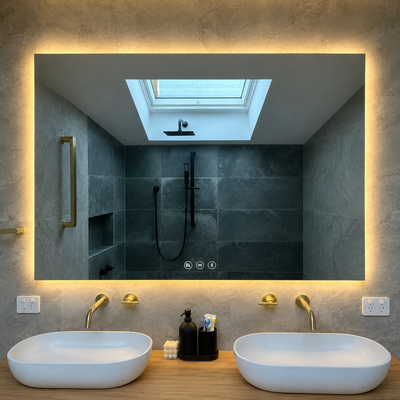
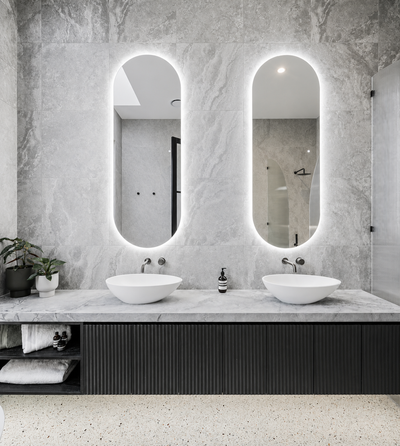
Modern bathrooms favour frameless rectangle mirrors with clean, unbroken edges, often paired with floating vanities and backlit lighting for a soft architectural glow. The goal is a mirror that reads as part of the wall rather than an applied decoration.

Contemporary
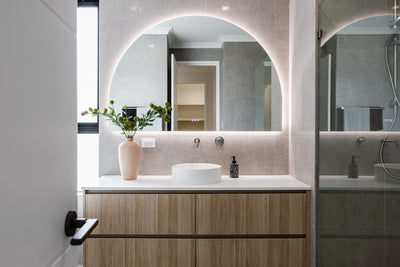
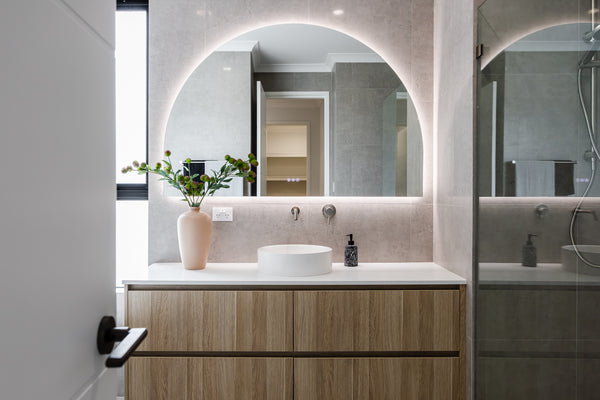
Contemporary bathrooms soften modern's hard edges with gentle geometry — an arch mirror, layered lighting and a neutral palette that feels current without being severe. This style borrows the cleanliness of modern design while allowing a little more warmth.

Hamptons
Hamptons bathrooms call for framed mirrors with symmetry and elegant proportions, typically in soft white, silver or brushed brass, paired with traditional detailing like panelled walls or classic tapware. Symmetry matters more here than in almost any other style.

Coastal
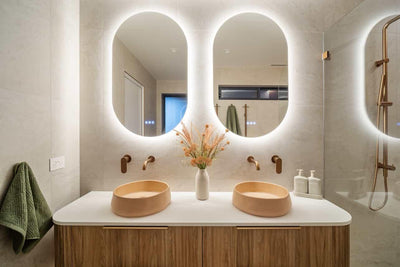
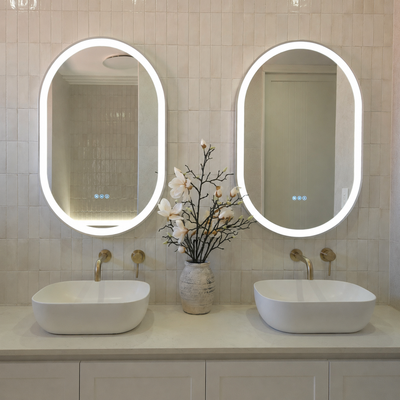
Coastal bathrooms favour soft curves, natural textures and light timber, paired with a relaxed, sun-faded palette. A round or oval mirror over a timber vanity captures the feel without leaning into literal beach motifs.

Organic Modern
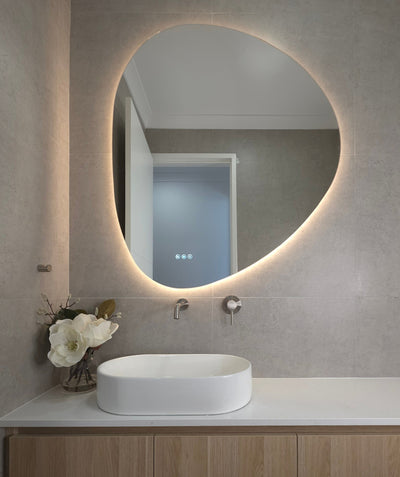
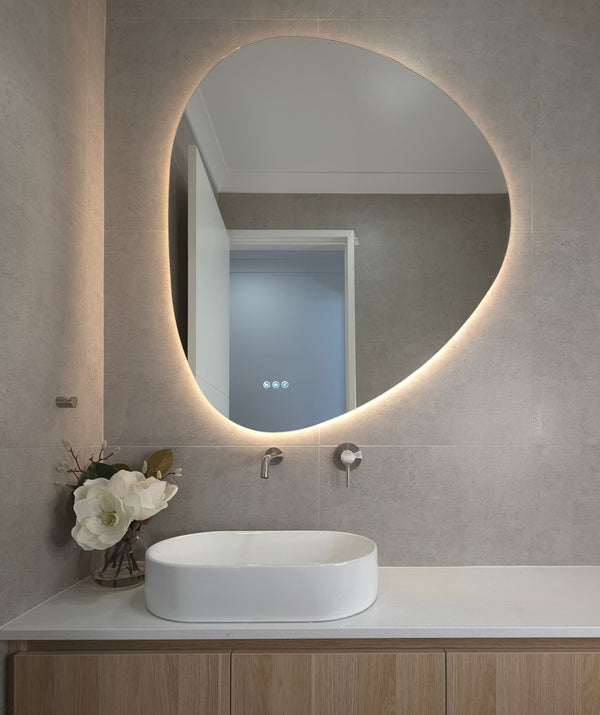
Organic Modern bathrooms embrace irregular, curved mirror shapes alongside travertine, walnut and other layered natural textures. This is the one style where an intentionally imperfect shape is the whole point.

Scandinavian
Scandinavian bathrooms rely on simplicity — light oak, white finishes, a round mirror and minimal accessories. Nothing here is decorative for its own sake; every element, including the mirror, needs to earn its place.

Japandi
Japandi bathrooms blend Japanese restraint with Scandinavian warmth — calm spaces, warm neutrals, restrained decoration, soft lighting and natural materials. A soft-cornered rectangle or round mirror suits this balance better than a sharply geometric shape.

Industrial
Industrial bathrooms suit black-framed mirrors with strong geometry, set against concrete, steel and exposed texture. The frame should feel structural rather than decorative, echoing the room's raw materials. A frameless mirror can also work here, provided the surrounding materials carry enough texture on their own to avoid the room feeling under-detailed.

Luxury / Hotel Style
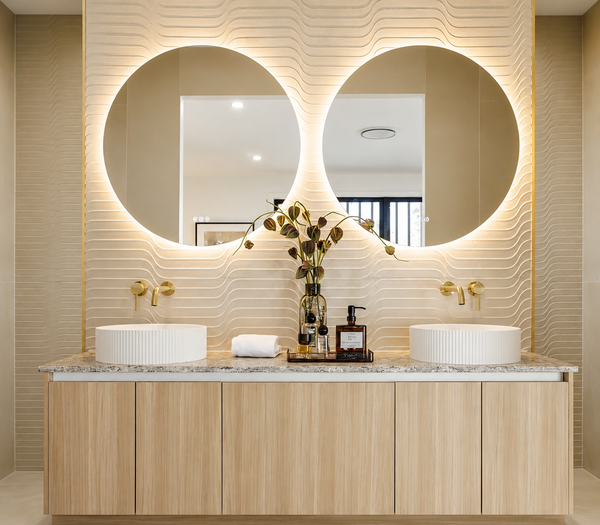
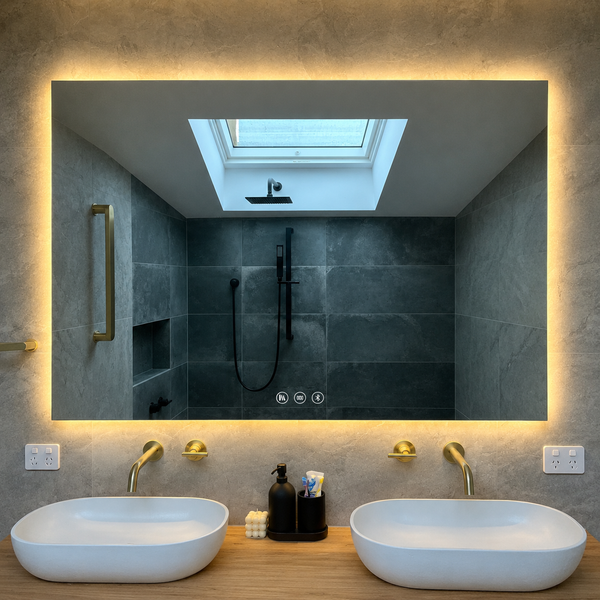
Luxury and hotel-style bathrooms favour oversized backlit LED mirrors, often in pairs over a double vanity, with symmetry and layered lighting doing most of the work. Scale and restraint together are what create the hotel feeling, not additional decoration. This is also the style where quality of light matters most — a warm, even glow reads as considered, while a harsh or uneven light undoes the effect no matter how large or expensive the mirror is.

Matching Mirror Shapes to Styles
Rectangle mirrors are the most flexible shape and suit modern, contemporary and industrial bathrooms particularly well. Round mirrors soften a room and suit Scandinavian, coastal and Japandi styling. Arch mirrors add height and a touch of formality, working well in contemporary, Hamptons and luxury bathrooms. Oval mirrors sit between round and arch, offering a softer alternative for coastal and transitional spaces. Organic shapes suit Organic Modern and eclectic interiors, where the mirror is meant to be noticed as a design feature.
For a deeper breakdown of how each shape affects a room, see our Round vs Arch vs Rectangle Bathroom Mirrors guide.
Designer Insight: repeating a curve or a straight line that already exists elsewhere in the room — an arched doorway, a curved basin, a rectangular window — creates cohesion in a way that choosing a shape in isolation never quite achieves.
Choosing Lighting for Each Style
Frontlit lighting delivers strong, even task light and suits modern, industrial and family bathrooms where practicality matters most. Backlit lighting creates a soft ambient glow and suits luxury, Hamptons and Japandi bathrooms aiming for a warmer, more atmospheric feel. Combined lighting — both frontlit and backlit in the one mirror — offers the flexibility to shift between the two depending on the time of day, and increasingly appears in higher-end contemporary and luxury bathrooms.
For a full comparison of the two lighting styles, see our Frontlit vs Backlit LED Bathroom Mirrors guide.
Mirror Cabinets Within Different Styles
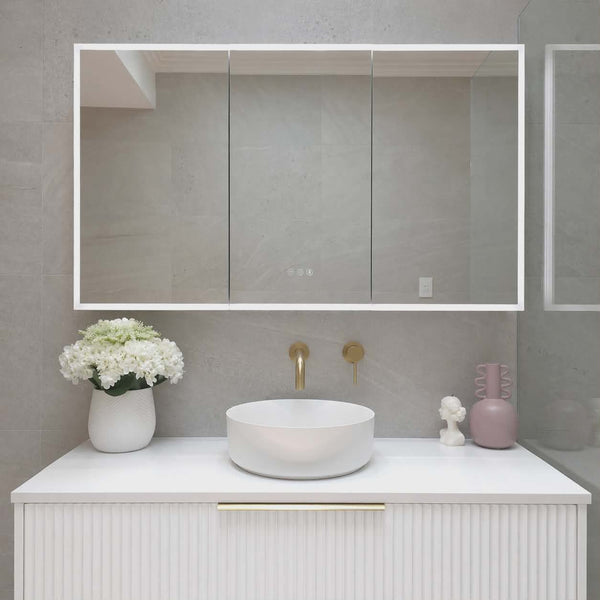
A mirror cabinet doesn't need to compromise a bathroom's aesthetic — the key is choosing a profile that matches the room's existing detailing. A slim, frameless cabinet integrates seamlessly into modern and Scandinavian bathrooms, while a framed cabinet can suit Hamptons or traditional spaces without looking like an obvious storage addition. In industrial or luxury bathrooms, a flush, built-in cabinet keeps the wall looking considered rather than functional.
For guidance on when a cabinet makes more sense than a standard mirror, see our Mirror Cabinet or Bathroom Mirror? guide.

Colour & Finish Pairings
A mirror's finish should echo the materials and hardware already in the room. Against white stone, travertine or marble, a simple frameless mirror lets the natural material stay the visual hero. Against timber, both frameless and lightly framed mirrors work, depending on how much warmth the room already has. Black tapware pairs naturally with black or gunmetal framing; brushed brass pairs with a warm gold-toned frame; brushed nickel pairs with silver or chrome framing; matte black hardware suits the same darker, more structural frame choices as an industrial-leaning room.
Designer Insight: lighting often has a bigger impact on how luxurious a bathroom feels than the finish of the mirror itself — a well-lit simple mirror will usually outperform a heavily finished mirror in poor light.
Common Styling Mistakes
- Choosing trends over architecture: a mirror chosen for a moment rarely suits the home for long.
- Mixing too many styles: a Hamptons frame in an otherwise industrial room reads as an afterthought.
- Oversized frames in minimalist rooms: a heavy frame adds visual weight a simple room can't spare.
- Poor lighting choices: a beautiful mirror lit as an afterthought undermines the whole design.
- Ignoring proportion: a mirror sized to the wall rather than the vanity beneath it rarely looks intentional.
Designer Insight: restrained styling generally ages better than trend-driven styling. The bathrooms that still look considered a decade after renovation are rarely the boldest ones — they're the ones built on a small number of well-matched decisions.
Expert Designer Recommendations
Designer's Rules
- Let the mirror support the architecture rather than compete with it.
- Repeat curves or straight lines already present in the room to create cohesion.
- Choose lighting before finish — it changes the room's character more than any material.
- When unsure, choose restraint — it ages better than a trend-driven choice.
Comparison Tables
Bathroom Style → Recommended Mirror Shape
| Bathroom Style | Recommended Shape |
|---|---|
| Modern | Rectangle, frameless |
| Contemporary | Arch or soft rectangle |
| Hamptons | Framed arch or rectangle |
| Coastal | Round or oval |
| Organic Modern | Organic / irregular |
| Scandinavian | Round |
| Japandi | Soft-cornered rectangle or round |
| Industrial | Rectangle, strong geometry |
| Luxury / Hotel | Oversized rectangle or arch |
Bathroom Style → Recommended Lighting
| Bathroom Style | Recommended Lighting |
|---|---|
| Modern | Backlit |
| Contemporary | Combined |
| Hamptons | Backlit |
| Coastal | Frontlit |
| Organic Modern | Combined |
| Scandinavian | Frontlit |
| Japandi | Backlit |
| Industrial | Frontlit |
| Luxury / Hotel | Backlit, layered |
Bathroom Style → Suggested Frame Finish
| Bathroom Style | Suggested Frame Finish |
|---|---|
| Modern | Frameless |
| Contemporary | Frameless or silver |
| Hamptons | Silver or gold-toned |
| Coastal | Frameless |
| Organic Modern | Frameless |
| Scandinavian | Frameless |
| Japandi | Frameless |
| Industrial | Black |
| Luxury / Hotel | Frameless or gold-toned |
Bathroom Style → Best Vanity Pairing
| Bathroom Style | Best Vanity Pairing |
|---|---|
| Modern | Floating, minimal handles |
| Contemporary | Floating or freestanding, neutral tones |
| Hamptons | Freestanding, painted timber |
| Coastal | Light timber, freestanding |
| Organic Modern | Natural stone or raw timber |
| Scandinavian | Light oak, simple lines |
| Japandi | Warm timber, low profile |
| Industrial | Concrete or steel-framed |
| Luxury / Hotel | Double vanity, stone benchtop |
Bathroom Style → Overall Design Character
| Bathroom Style | Design Character |
|---|---|
| Modern | Clean, minimal, architectural |
| Contemporary | Current, softened, approachable |
| Hamptons | Classic, symmetrical, elegant |
| Coastal | Relaxed, light, natural |
| Organic Modern | Textural, sculptural, natural |
| Scandinavian | Simple, functional, quiet |
| Japandi | Calm, warm, restrained |
| Industrial | Raw, structural, bold |
| Luxury / Hotel | Grand, symmetrical, atmospheric |
Frequently Asked Questions
What mirror suits a modern bathroom?
A frameless rectangle mirror, ideally backlit and sized to match a floating vanity, is the most reliable choice for a modern bathroom.
What mirror suits Hamptons?
A framed arch or rectangle mirror in silver or brushed brass, positioned symmetrically, suits Hamptons styling's classic proportions.
Can frameless mirrors work in traditional homes?
Yes, though they tend to suit transitional spaces better than heavily traditional ones — pairing a frameless mirror with warmer materials and softer lighting helps it feel less stark.
What mirror suits Scandinavian interiors?
A plain, frameless round mirror with no additional ornamentation suits Scandinavian design's quiet, functional approach.
How do I make my bathroom look luxurious?
Scale and lighting create a luxurious feel more reliably than finish alone — an oversized, well-lit mirror in a restrained setting reads as more considered than a smaller, heavily decorated one. Pairing that mirror with symmetry, especially on a double vanity, reinforces the effect further.
Are LED mirrors timeless?
A well-proportioned LED mirror in a simple frame or frameless design tends to remain timeless, since the lighting adds function without dating the mirror's shape or finish.
Designer's Cheat Sheet
Designer's Cheat Sheet
- ✔ Modern → Frameless rectangle, backlit
- ✔ Hamptons → Framed arch, symmetrical
- ✔ Coastal → Round or oval, light timber
- ✔ Scandinavian → Plain round, minimal styling
- ✔ Luxury → Oversized, backlit, symmetrical
- ✔ Not sure? → Choose restraint over trend
Conclusion
Choosing a bathroom mirror by style rather than trend comes down to a handful of consistent principles: read the room's existing materials and hardware, match the mirror's shape and frame to those lines, and let lighting do more of the work than an elaborate finish. A mirror chosen to complement your home's architecture, rather than to chase a passing look, will generally remain stylish for many years — through renovations, resales and changing trends alike.
Ready to find the right style for your home? Explore our complete Smart Mirrors and Mirror Cabinets collections, or browse our Best Sellers if you're not sure where to start.
Where To Next?
- Start here: The Ultimate Bathroom Mirror Buying Guide (2026 Edition)
- For inspiration: Bathroom Mirror Ideas: 25 Designer-Approved Ideas for Every Bathroom Style
- Related guides: Best Bathroom Mirrors for Small Bathrooms, Double Vanity Mirror Guide: One Large Mirror or Two Mirrors?, Round vs Arch vs Rectangle Bathroom Mirrors: Which Shape Is Right?, How to Choose the Right Mirror Size for Your Vanity, How High Should You Hang a Bathroom Mirror?, Frontlit vs Backlit LED Bathroom Mirrors, LED Mirror Features Explained and Mirror Cabinet or Bathroom Mirror?
- Browse: the full Smart Mirrors range
- Need storage: the full Mirror Cabinets range
- Not sure where to start: our Best Sellers

