


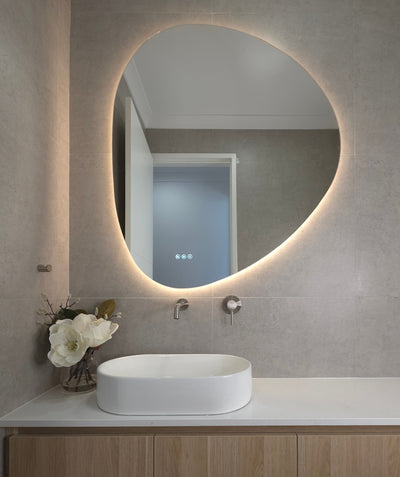
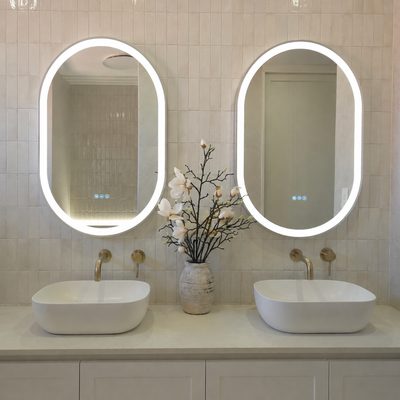
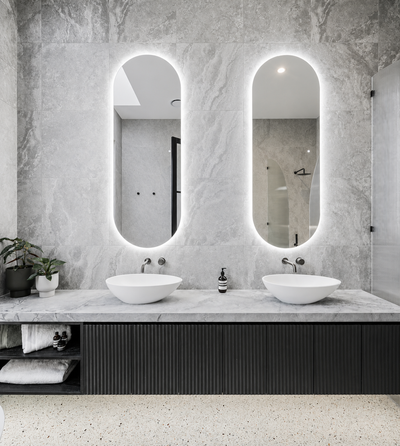



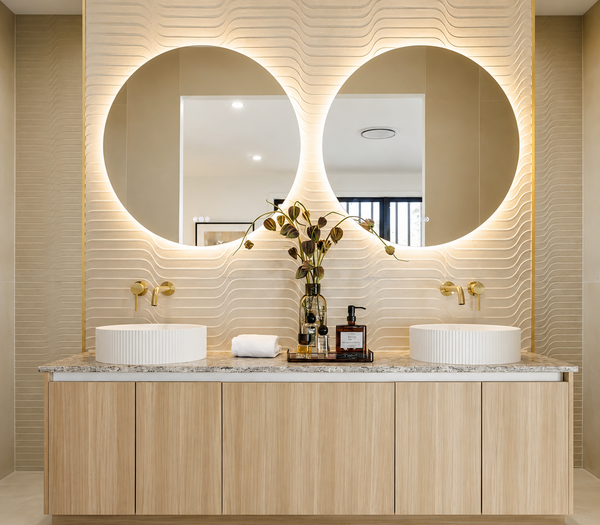
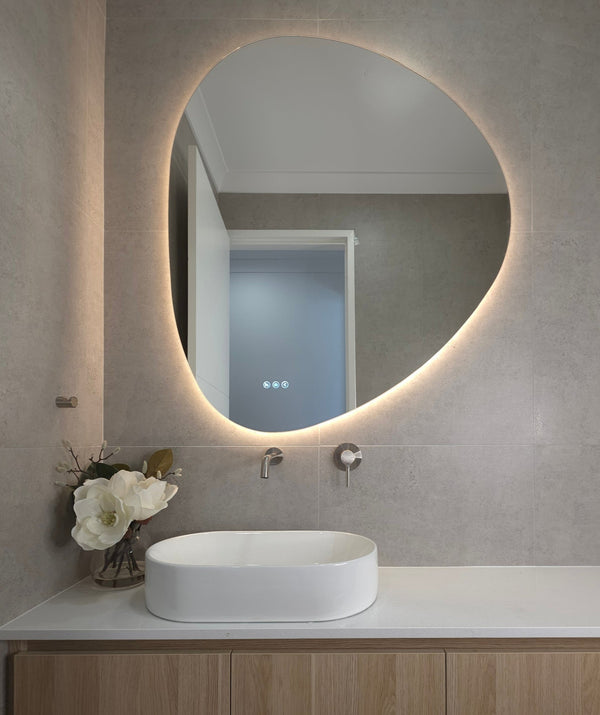
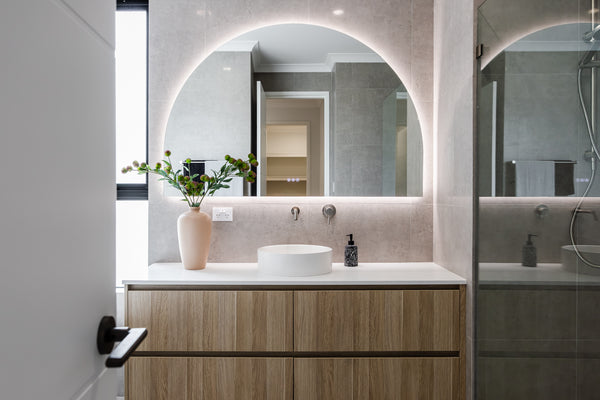
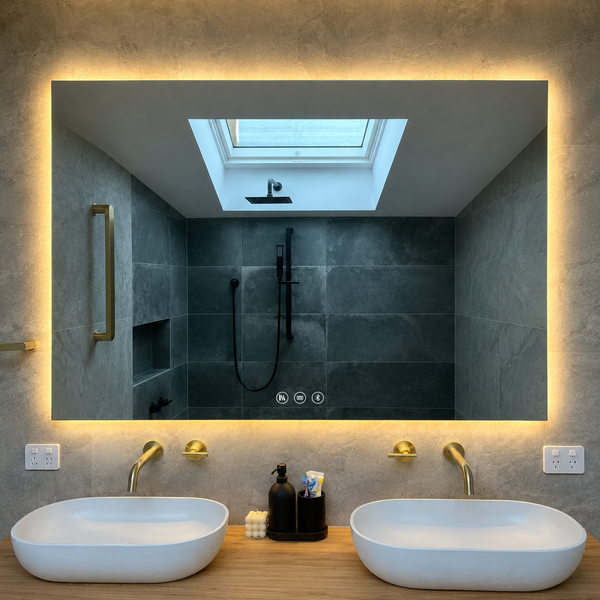
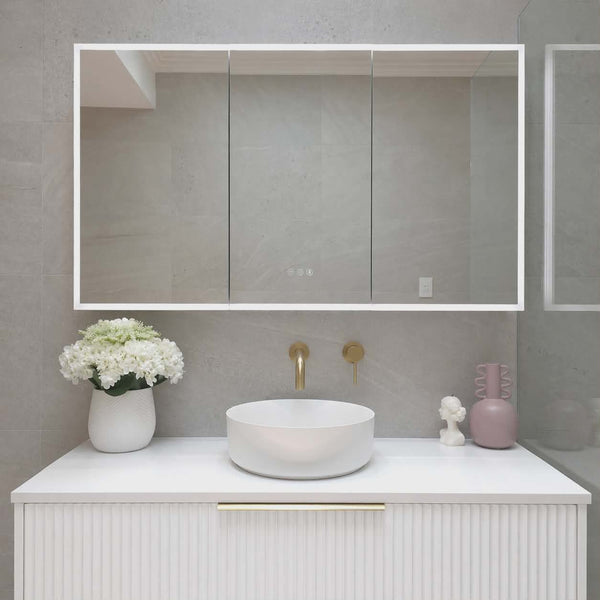

The question usually comes up after someone has fallen for a mirror and looked for the plug. There isn't one. Every LED wall mirror and mirror cabinet we sell is hardwired, which means it connects to the fixed wiring behind the glass, and that connection is a job for a professional.
That isn't a reason to avoid one. It just changes the order of the job. This guide explains the difference between hardwired and plug-in mirrors, exactly where the cable sits on ours, when to book the licensed electrical worker, what to hand them, and the rules that apply in New Zealand.
Updated 13 October 2026. Product details come from our installation guides and product specifications.
Why Trust InVogue Mirrors & Bathware? InVogue is a mirror and bathware brand trusted in over 20,000 homes, specialising in LED bathroom mirrors and mirror cabinets. The recommendations in this guide come from bathroom design principles — proportion, balance and light — rather than passing trends.
Electrical work: every step that touches the wiring must be done by a licensed electrical worker. This guide explains what to plan and ask for. It is general information, not installation instructions.
Quick Answer
Yes, a hardwired LED mirror needs a licensed electrical worker. Every LED wall mirror and mirror cabinet we sell is hardwired, 220–240 V, with no plug, and must be installed by a licensed electrical worker.
- Mirrors: a pre-attached 3-core 0.75 mm² cable, 1 m long (1.5 m on the Venice 1800), exits the back near the centre. The wiring point goes behind the glass.
- Cabinets: a fixed 1050 mm lead leaves the back of the body at the top edge, centred. The join is made in the wall behind the body.
- Book the electrician before the wall is lined or tiled, and mark the mirror's outline first.
- All are IP44 and RCM compliant. Your electrician confirms the bathroom zone and RCD protection under AS/NZS 3000.
- Our 2-year warranty asks for licensed installation, following our installation guide.
Do LED Mirrors Need an Electrician?
A hardwired one does, and a plug-in one doesn't, provided there's already a suitable power point where the lead can reach it. That's the whole answer in one line. The catch is that most bathrooms don't have a power point where a mirror's lead could reach it without a cable hanging down the wall, so a plug-in mirror often needs electrical work too.
Our wall range is hardwired across the board: every frameless and framed LED wall mirror, and every mirror cabinet. The supply cable is fixed to the mirror at the factory, and a licensed electrical worker connects it to a wiring point in the wall behind it. You never see a lead, a plug or a power point. The only exceptions are our portable make-up mirrors, which charge by USB-C and need no installation at all.

Hardwired vs Plug-In LED Mirrors
Hardwired is the cleaner, permanent option. Plug-in is the flexible one. Here's how they actually compare once they're on the wall.
| Hardwired (all of ours) | Plug-in | |
|---|---|---|
| How it connects | To a wiring point in the wall behind the glass | Into a power point, by a lead |
| What you see | Nothing. The connection is hidden behind the mirror | A lead, unless a power point sits behind or right beside the mirror |
| Who installs it | You fix the brackets. A licensed electrical worker makes the connection | You hang it and plug it in. Adding a power point is electrical work |
| Where it can go | Where your electrician confirms it suits the bathroom zones | The power point has to suit the zones too |
| Best for | Renovations and owner-occupied homes | Rentals, or a room where no electrical work is possible |
General comparison. Our products: hardwired, 220–240 V, 50 Hz, IP44, RCM compliant (installation guides).

Here's the honest limit: if you rent and your landlord won't agree to electrical work, a hardwired mirror is the wrong buy, ours included. In that situation a plug-in or unlit mirror makes more sense. For everyone else, a hardwired mirror is no harder to live with. It costs one extra trade visit, and it never leaves a lead on show.
Where the Cable Goes Behind an LED Mirror
On our LED mirrors the cable comes out of the back, near the centre. It's pre-attached, 3-core 0.75 mm², and 1 m long on every size except the Venice 1800 × 1000, which has 1.5 m. The electrician places the wiring point on the wall behind the mirror, near the centre of where it will hang, so the connection ends up hidden behind the glass.
The practical consequence: the mirror's position is fixed the moment the wiring point goes in. Mark the outline on the wall first, using our mirror height guide (centre about 1500 to 1650 mm above the floor, bottom edge 100 to 200 mm above the tap or splashback), and show the electrician the outline, not a rough idea.

Mirror cabinets: the lead leaves the top of the body
Our bracket-hung cabinets (Milan, Madrid, Santander, Lucca, Riviera and Positano) work differently. The supply lead is a fixed 3 × 0.75 mm² tail, 1050 mm long, that leaves the back of the cabinet body at the top edge, centred. The electrician makes the join in the wall directly behind that point, or anywhere else behind the body where a space is made. Either way it's hidden behind the cabinet. The Milan manual (PDF) shows the join zone. The Amalfi cabinet hangs differently, so follow its own manual.

Every cabinet also has a 10 A power outlet inside, the "mirror cabinet with power socket" people search for. It's handy for an electric toothbrush, a shaver or a phone charger, and it means no separate power point on the splashback.
When to Book the Electrician
Book the electrician before the wall is lined or tiled, and plan on two visits. The first places the wiring point. The second, after the wall is finished and the brackets are up, connects the mirror.
- Choose the mirror and mark its outline on the wall.
- First visit: the licensed electrical worker places the wiring point inside the outline and confirms the zone and RCD protection.
- Line, tile and paint. Add noggins for the brackets before the lining goes on.
- Fix the wall brackets into studs, noggins or masonry.
- Second visit: the licensed electrical worker connects the cable with the supply isolated while a helper holds the mirror. Then you hang it together and test it.

Replacing an existing builder's mirror is the same job with a step in front: getting the old glass off. Our guide to replacing a builder's mirror covers removal, patching and fixings.
Bathroom Zones, IP44 and RCDs
Your licensed electrical worker decides whether the spot you've chosen is allowed. AS/NZS 3000, the Wiring Rules cited in New Zealand's electrical safety regulations, sets zones around baths and showers that limit which electrical equipment can go where. How those zones fall in your bathroom depends on where the bath, shower and screens are, so we don't print distances here. Your electrician measures the room and confirms the position, and checks the circuit has RCD protection.
Our mirrors and cabinets are rated IP44. That means splash-resistant, not waterproof: fine above a vanity, not something to put inside a shower. They're also RCM compliant, the mark that shows electrical equipment meets the safety requirements for sale in New Zealand.
Designer Insight: in a small ensuite the vanity often sits right beside the shower. If your mirror wall is shared with a shower or close to a bath, ask the electrician to check the position before you order the size, not after.
The Brief for Your Electrician
Hand your electrician this table, or the "Planning" page from the installation guide (for example, the Santander guide (PDF)). It answers the questions they'll ask.
| Item | LED mirror | Mirror cabinet |
|---|---|---|
| Supply | 220–240 V, 50 Hz. Hardwired, no plug | 220–240 V, 50 Hz. Hardwired, no plug |
| Cable | 3-core 0.75 mm², 1 m (Venice 1800: 1.5 m), pre-attached | Fixed 3 × 0.75 mm² tail, 1050 mm |
| Cable exit | Back of the mirror, near the centre | Back of the body, top edge, centred |
| Wiring point or join | On the wall behind the mirror, near the centre of its position | In the wall behind the body, directly behind the exit or anywhere behind the body |
| Rating | IP44, RCM compliant | IP44, RCM compliant |
| Zone and RCD | Electrician confirms under AS/NZS 3000 | Electrician confirms under AS/NZS 3000 |
| Switching | Electrician advises on switching and isolation | Electrician advises on switching and isolation |
| Extra | Remembers colour and brightness after power-off | 10 A power outlet inside |
Source: our LED mirror installation guides and mirror cabinet manuals.

One detail worth deciding early is switching. Some people want the mirror on its own wall switch, some want it with the room light, and some leave it on its touch controls alone. Because our mirrors come back on at the colour and brightness they were last set to, any of these works. Your electrician will tell you what suits the circuit.
The Rules in New Zealand
Electrical work in New Zealand is regulated under the Electricity Act 1992 and the Electricity (Safety) Regulations 2010, with WorkSafe NZ as the regulator. WorkSafe's guidance on doing your own electrical work allows owner-occupiers only limited work on their own home, without payment and under strict conditions, and none at all on rental properties. Its own advice is that if you're in any doubt, use a licensed worker.
That's our advice too. We recommend a licensed electrical worker for every LED mirror and mirror cabinet we sell, and our warranty asks for licensed installation following our installation guide. You can check a licence on the Electrical Workers' Register, and our installation guides have a record page with a space for the licence number and the date installed.
Common Mistakes
- Buying first and looking for the plug later. Ours have none. Budget for the electrician when you budget for the mirror.
- Tiling before the wiring point is in. Once the wall is finished, adding a point behind the mirror means cutting into it.
- Putting the point where the old mirror was centred. Mark the new outline first. A different size or height moves the centre.
- A power point above a cabinet. Our cabinet lead leaves the back of the body, so the join belongs in the wall behind it, not on show above.
- Leaving switching to the day. Decide on a wall switch or touch controls only before the rough-in.
- Doing the connection yourself. It's work for a licensed electrical worker, and our warranty asks for licensed installation.
Frequently Asked Questions
Do LED mirrors need an electrician?
A hardwired LED mirror does. It connects to the fixed wiring behind the glass, and that connection is electrical work for a licensed electrical worker. A plug-in mirror only needs a suitable power point within reach of its lead, although adding that power point is also electrical work. Every LED wall mirror and mirror cabinet we sell is hardwired, 220 to 240 V, with no plug.
Can you plug in an LED bathroom mirror?
Only if it was made as a plug-in model. Ours are not: they have a pre-attached supply cable with bare tails for an electrician to connect, and no plug. Fitting a plug to a hardwired mirror is not a workaround. It leaves a lead on show and puts a connection somewhere it was never designed to be.
Where should the power point be for an LED mirror?
For our mirrors, there isn't a power point. The electrician places a wiring point on the wall behind the mirror, near the centre of where it will hang, so the 1 m cable reaches it and the connection hides behind the glass. Mark the mirror's outline on the wall first, because that point fixes the mirror's position.
Can an LED mirror be wired to the light switch?
Your electrician advises on switching and isolation, and either arrangement is common. If the mirror is on a wall switch, it doesn't lose its settings: our mirrors remember the colour and brightness they were set to before they were switched off, and come back on that way. Decide before the rough-in, not on the day.
Is an LED mirror safe in a bathroom?
Ours are rated IP44, which means splash-resistant, and are RCM compliant. Where it can go is set by the bathroom zones in AS/NZS 3000, which depend on where your bath, shower and screens are. Your licensed electrical worker measures the room, confirms the position and checks the circuit has RCD protection.
Does a mirror cabinet need its own power point?
Not a separate one on the wall. Our bracket-hung cabinets have a fixed supply lead, 1050 mm long, that leaves the back of the body at the top edge, centred, and the electrician joins it inside the wall behind the cabinet. Inside, each cabinet has a 10 A power outlet for an electric toothbrush, shaver or phone charger.
Can I install an LED mirror myself in NZ?
You can do the parts that aren't electrical: take the old mirror off, mark the outline, fix the brackets into studs, noggins or masonry, and hang it with a helper. WorkSafe NZ allows owner-occupiers only limited electrical work on their own home, under strict conditions. We recommend a licensed electrical worker for the connection, and our warranty asks for licensed installation.
Designer's Cheat Sheet
Designer's Cheat Sheet
- ✔ Hardwired? → Yes, every wall mirror and cabinet of ours. Licensed electrical worker connects it
- ✔ Plug? → None. No power point needed behind a mirror
- ✔ Mirror cable? → Back, near the centre, 1 m (Venice 1800: 1.5 m)
- ✔ Cabinet lead? → Back of the body, top edge, centred, 1050 mm
- ✔ When? → Before lining and tiling, then again to connect
- ✔ Zones and RCD? → Your electrician confirms, under AS/NZS 3000
Conclusion
A hardwired mirror asks for one thing a plug-in doesn't: a decision about position before the wall is finished. Make that decision, give the licensed electrical worker the outline and the brief, and the result is a mirror with no lead, no plug and nothing to see but the glass.
Still choosing? Compare features in LED Mirror Features Explained, or see whether one suits you in Are LED Mirrors Worth It?
Where To Next?
- Related guides: Replacing a Builder's Mirror with an LED Mirror or Cabinet, Recessed vs Surface-Mounted Mirror Cabinets, The Ultimate Bathroom Mirror Buying Guide and The Ultimate Mirror Cabinet Buying Guide
- Mirrors: the Amalfi, Santander and Florence, or the full Smart Mirrors range
- Cabinets: the Milan and Madrid, or the full Mirror Cabinets range
Need help? Ask us with a photo.
Send a photo of your wall, vanity or plans and we will tell you what fits, or email info@invoguemirrors.co.nz.

