








Mirror shape is the decision most bathroom renovations get right by accident rather than design. Vanity width gets measured, tapware gets chosen, tiles get sampled — and then the mirror is picked last, often by whatever looks nice in a photo. But shape is what decides whether the finished room feels calm and considered or slightly off, in a way that's hard to name but easy to notice.
This bathroom mirror buying guide explains how round, arch, rectangle and organic bathroom mirror shapes each change the way a New Zealand bathroom looks and feels — by style, by vanity, by ceiling height — so you can choose with the same reasoning a bathroom designer would use, matched to real InVogue LED bathroom mirrors along the way.
13 min read • Last reviewed: 22 July 2026 • Written by the InVogue Mirrors & Bathware Team
Why Trust InVogue Mirrors & Bathware? InVogue is an Australian-designed mirror and bathware brand trusted in over 10,000 New Zealand homes, specialising in LED bathroom mirrors and mirror cabinets. The recommendations in this guide come from bathroom design principles — proportion, balance and light — rather than passing trends.
Quick Answer
- Round: softens a room full of straight lines — best in powder rooms, ensuites, and coastal or Mediterranean-style bathrooms.
- Arch: the middle ground — adds a curve without losing structure. Suits transitional, Hamptons and luxury bathrooms.
- Rectangle: the most flexible shape — strongest in contemporary, minimalist, industrial and family bathrooms, and the easiest shape to pair on a double vanity.
- Organic / Irregular: a statement piece — suits Organic Modern and eclectic interiors where the mirror is meant to be noticed, not just used.
Mirror Shape at a Glance
- → Round: Soft, calming, ideal for compact spaces
- → Arch: Elegant balance of curve and structure
- → Rectangle: Clean, timeless and highly versatile
- → Organic: Artistic statement piece
A snapshot before the detail — read on for the reasoning behind each shape.
Why Mirror Shape Matters
A mirror is usually the largest single object on a bathroom wall, which means its shape does more to set the room's tone than almost any other fixture. A rectangle reads as architectural and deliberate; a circle reads as soft and informal; an organic outline reads as artistic. Before it reflects anything, the shape itself is already telling the room what style it belongs to.
Shape also changes how a room feels regardless of the mirror's actual size. A round mirror carries less visual width than a rectangle of the same diameter, so it sits closer to full vanity width without overwhelming a small room. An arch or tall vertical mirror draws the eye upward, making a standard ceiling feel taller; a wide horizontal rectangle does the opposite, anchoring the room and keeping it feeling grounded.
Shape interacts with lighting, too. A round or arch mirror's curved backlit edge diffuses light softly around the frame, suiting a relaxed, ambient mood; a rectangle's straight LED edge reads as cleaner and more directional, suiting a crisp, contemporary look. On a double vanity, shape also governs symmetry — two identical mirrors reinforce order, while two different shapes almost always read as a mismatch.
New Zealand bathrooms have shifted noticeably toward softer, more organic forms in recent years, without abandoning the clean rectangle — most renovations now sit somewhere between the two, using one shape as the anchor and a second, softer shape elsewhere in the room to balance it.
Designer Insight: one curve rarely looks intentional on its own — it can read as an odd choice against an otherwise straight-lined room. Repeating that same curve somewhere else, in a basin, a tapware handle or a light fitting, is usually what makes a bathroom feel professionally designed rather than assembled piece by piece.

Round Mirrors
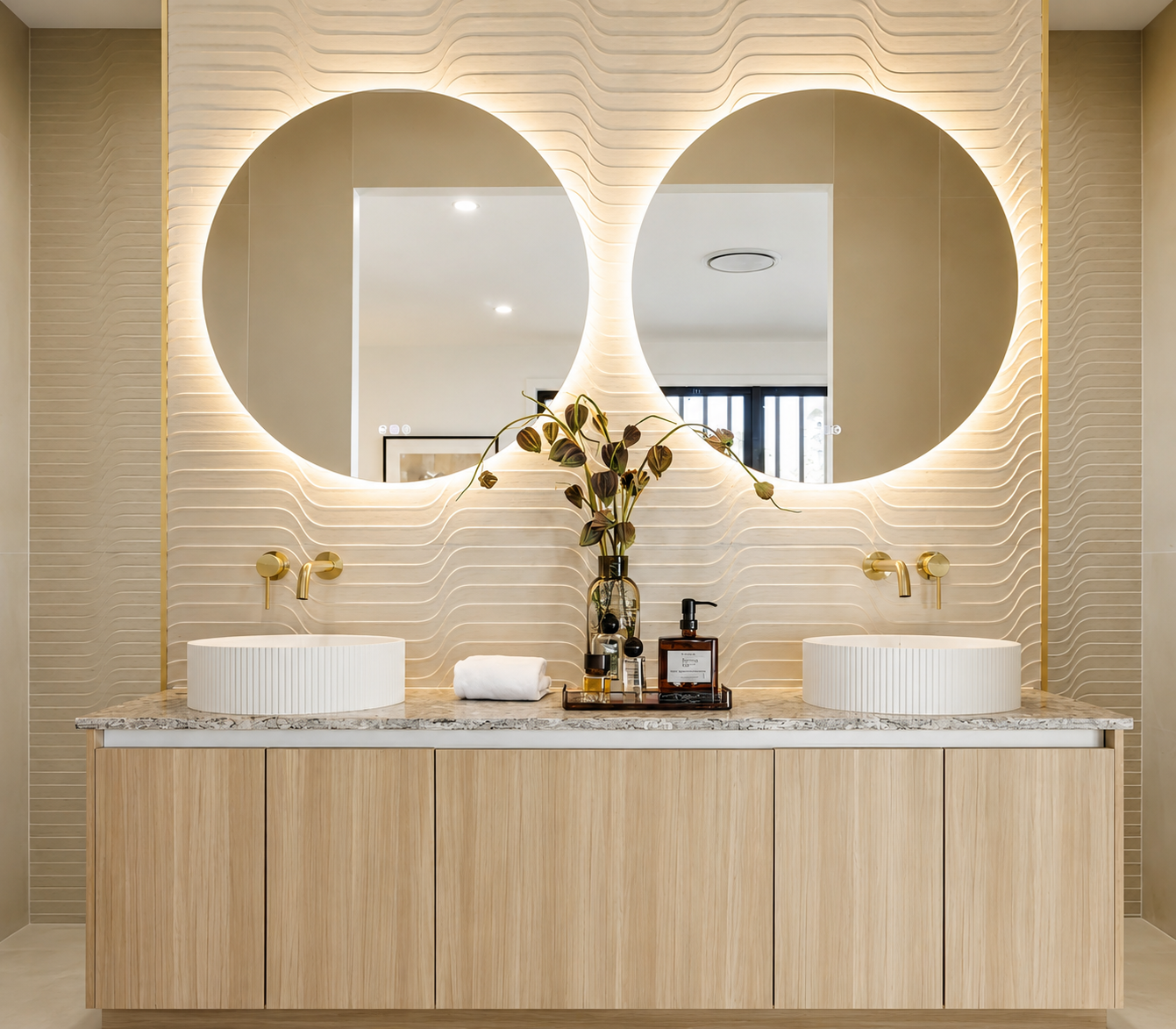
Round bathroom mirrors have no corners to draw the eye, so a circle reads as the calmest, softest shape available — the natural choice wherever a room is already full of hard lines and needs relief. Because a circle carries less visual width than a rectangle, round mirrors generally look best sized close to full vanity width rather than the narrower 70–90% rule that applies to rectangles.
Recommended: The Amalfi Smart Mirror, or the Amalfi Mirror Cabinet for rooms that need the softness of a circle without losing storage.
Designer Insight: most vanities and benchtops are rectangular, so a circle is the one shape with no edge that lines up with the benchtop's corners. That's precisely why it feels balanced rather than random — it's the only shape in the room that isn't competing with the vanity's own lines.

Arch Mirrors
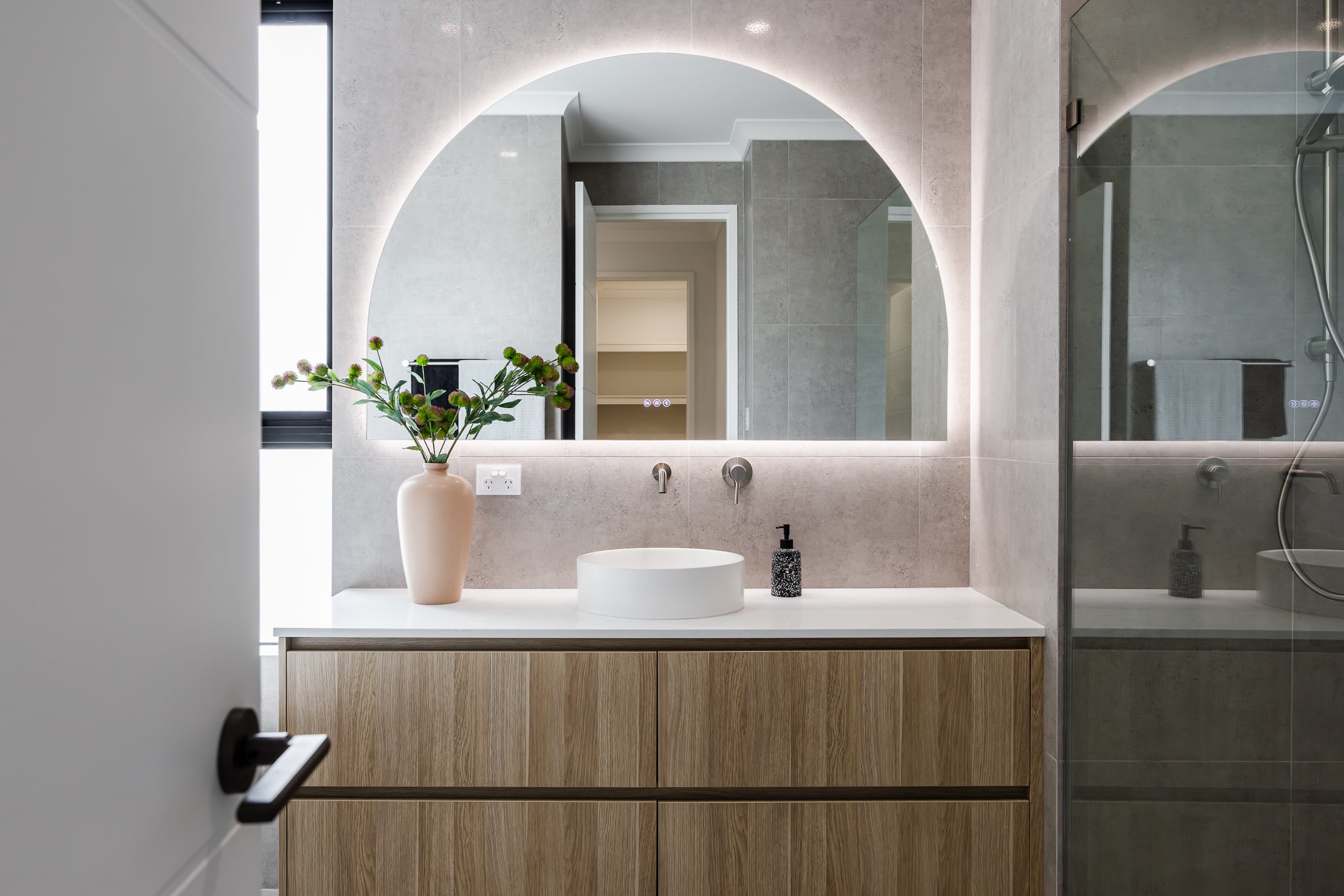
An arch keeps a rectangle's straight sides but replaces the top corners with a curve, which is why arch bathroom mirrors work as the middle ground between round and rectangle — structured enough for a considered bathroom, soft enough to avoid feeling clinical. The curve also draws the eye upward, so an arch mirror makes a standard-height wall feel a little taller than its actual measurements suggest. Pieces like The Positano show how gentle that curve can be while still reading as intentional, and how much more presence it gains once the backlit edge is switched on. (Backlighting itself is a separate decision — see our companion guide, Frontlit vs Backlit LED Mirrors.)

Rectangle Mirrors
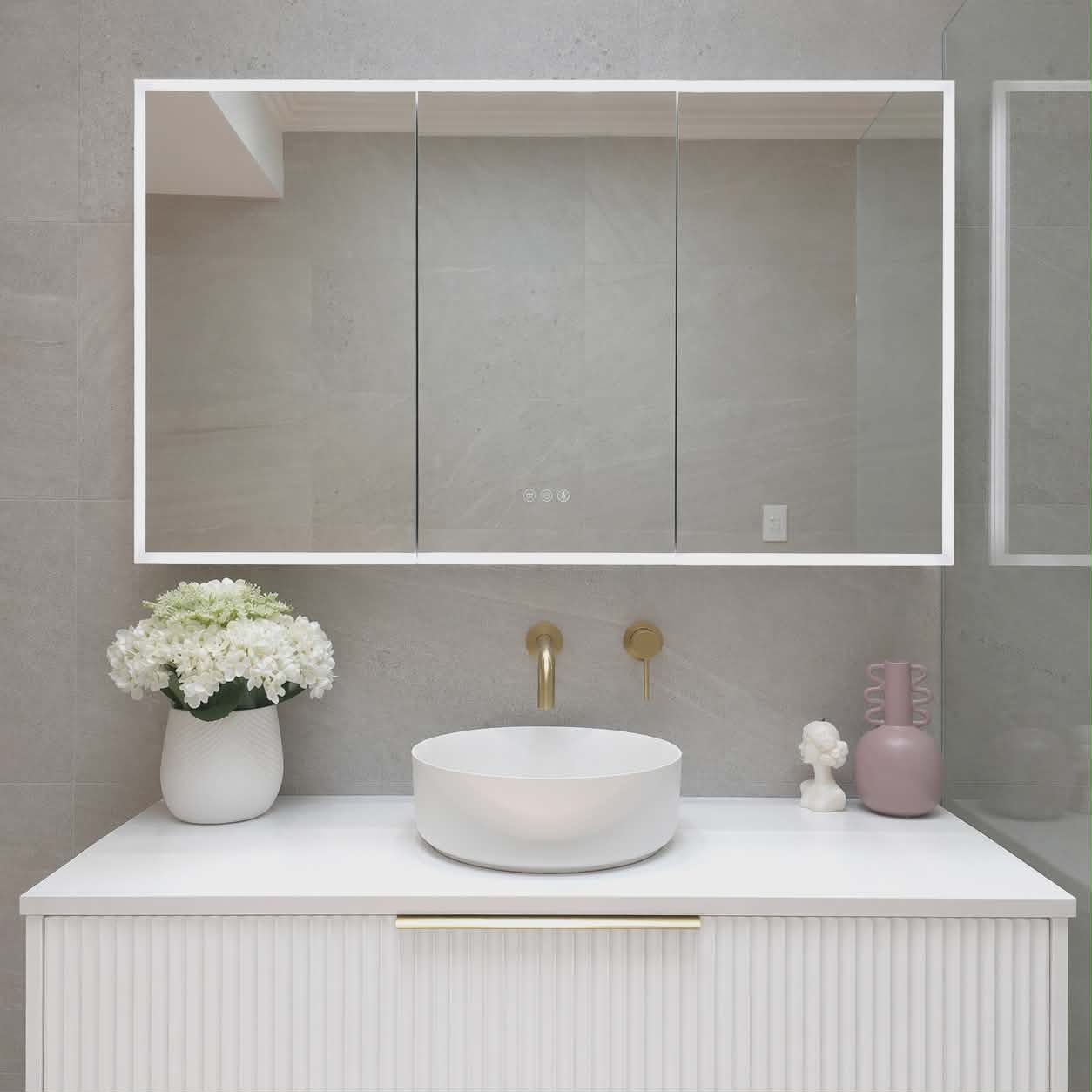
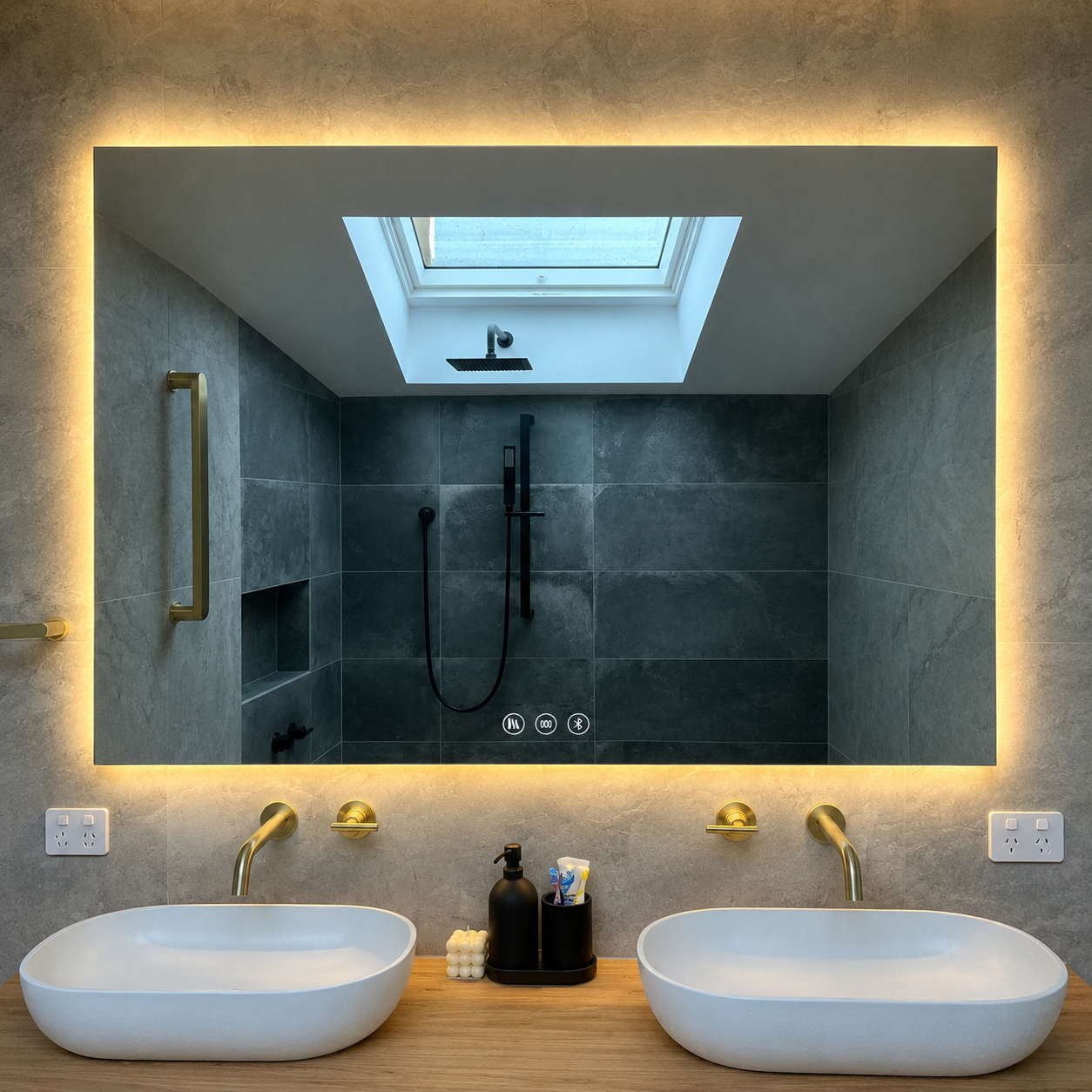
Rectangular bathroom mirrors are the most flexible shape in the range, because their straight edges hold their proportions in almost any room. A horizontal rectangle anchors a wide vanity and reads as calm and grounded; a vertical rectangle over a narrow single basin does the opposite job of an arch, using height rather than a curve to make the most of a taller wall. It's also the easiest shape to pair identically across a double vanity, since two straight-edged mirrors read as matched more forgivingly than two curved ones.
Recommended: The Florence Smart Mirror or The Venice Smart Mirror, and the Milan or Santander Mirror Cabinets where storage is the priority.
Designer Insight: a large, well-proportioned frameless rectangle usually reads as more expensive than a smaller mirror in a heavy frame. Scale and clean edges signal quality on their own — an ornate frame often does the opposite, drawing attention to itself rather than the room.

Organic & Irregular Mirrors
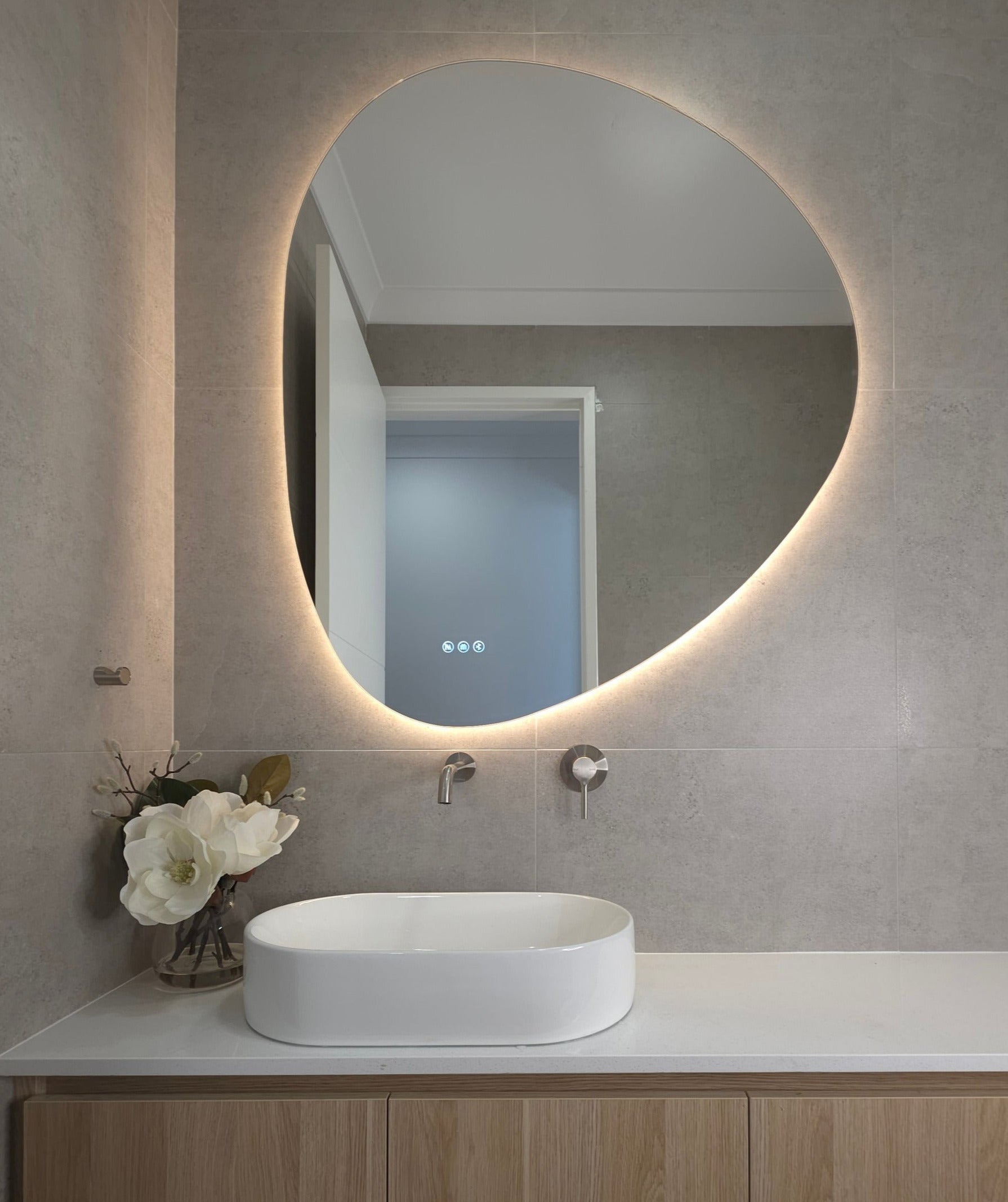
An organic mirror's uneven outline carries more visual weight than its measurements suggest, which is what makes it read as a statement piece rather than a fixture. It works best alone — a single sculptural shape against a plain, straight-edged vanity — rather than paired with a second mirror, since its outline is designed to be the one thing in the room that doesn't repeat. The Lucca is a good example of how much personality an irregular outline adds without the room needing any other ornamentation; The Riviera's soft vertical oval offers a subtler version of the same effect.

Mirror Cabinets vs Decorative Mirrors
Every shape above is available as either a frameless decorative mirror or a mirror cabinet with concealed storage — the shape decision and the storage decision are separate questions. As a rule of thumb, choose the shape first for how it should look, then decide whether that shape needs to work harder as a cabinet. For the full reasoning on when a cabinet makes more sense than a decorative mirror, see our companion guides, Mirror Cabinet or Bathroom Mirror? and our Bathroom Mirror Cabinet Guide.
Choosing By Bathroom Style
Shape is the fastest way to make a bathroom mirror belong to a style — a useful starting point for any bathroom renovation ideas board.

| Bathroom Style | Best Shape(s) | Why It Works |
|---|---|---|
| Contemporary | Rectangle, Arch | Clean lines suit contemporary's architectural simplicity; an arch adds one curved feature without breaking the look. |
| Coastal | Round, Organic | Coastal design favours natural, water-worn forms; a circular or organic outline echoes that softness against timber and light tones. |
| Scandinavian | Round, Rectangle | Scandi design prizes restraint; an unadorned, frameless round or rectangle suits the pared-back palette without added ornament. |
| Organic Modern | Organic/Irregular, Round | This style is built on imperfect, natural forms, so an organic outline becomes the intentional focal point rather than a compromise. |
| Minimalist | Rectangle, Round | Minimalism rewards one strong geometric statement — either shape works, provided the frame stays completely clean. |
| Hamptons | Arch, framed Rectangle | Hamptons leans on classic, slightly traditional lines; an arch or framed rectangle adds a coastal-classic reference without looking ornate. |
| Luxury | Arch (statement size), Rectangle | A larger arch or rectangle reads as a tailored, considered piece — scale communicates luxury more effectively than embellishment. |
| Industrial | Rectangle, Arch | Strong lines hold their own against exposed textures and raw materials better than a soft, rounded outline. |
| Mediterranean | Round, Arch | Mediterranean design draws on sun-worn curves and hand-finished forms — round and arch are the most direct echo of that heritage. |
Choosing By Vanity Width
Shape changes how much of the vanity a mirror should cover. Round and organic mirrors carry less visual width, so they suit narrower vanities or can run close to full width; rectangle and arch generally look best at 70–90% of the benchtop. For exact sizing by millimetre, see our companion guide, How to Choose the Right Mirror Size for Your Vanity.
| Vanity Width | Shapes That Work Best |
|---|---|
| 600mm | Round, Arch |
| 750–900mm | Rectangle, Round, Organic |
| 1200mm and above | Arch (statement size), Rectangle |
| Double vanity | Rectangle (single mirror), or two identical mirrors of any shape |

Choosing By Ceiling Height
Ceiling height changes which shapes make a room feel balanced rather than top-heavy or squat. Mirror height and mounting position are a related but separate decision — see our companion guide, How High Should You Hang a Bathroom Mirror?
| Ceiling Height | Best Shape(s) | Why |
|---|---|---|
| Under 2400mm (low or sloped) | Round, Organic | Keeps visual weight low and doesn't compete with the ceiling line. |
| Standard (~2400mm) | Rectangle (horizontal), Round | Balanced proportions without needing extra height to look right. |
| High (2700mm+) | Arch, Rectangle (vertical) | The curve or vertical line draws the eye upward, making full use of the extra wall height. |

Single Vanity vs Double Vanity
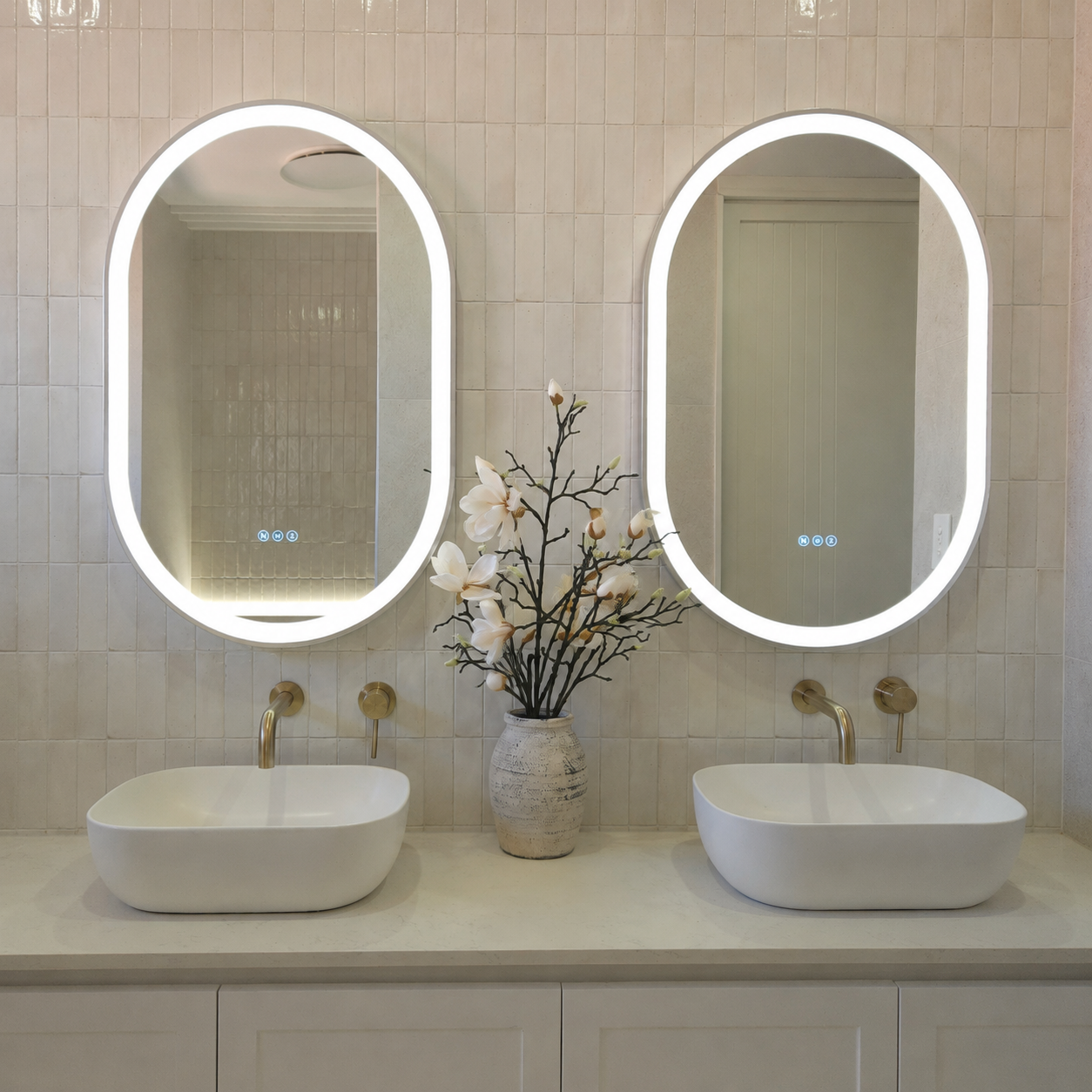
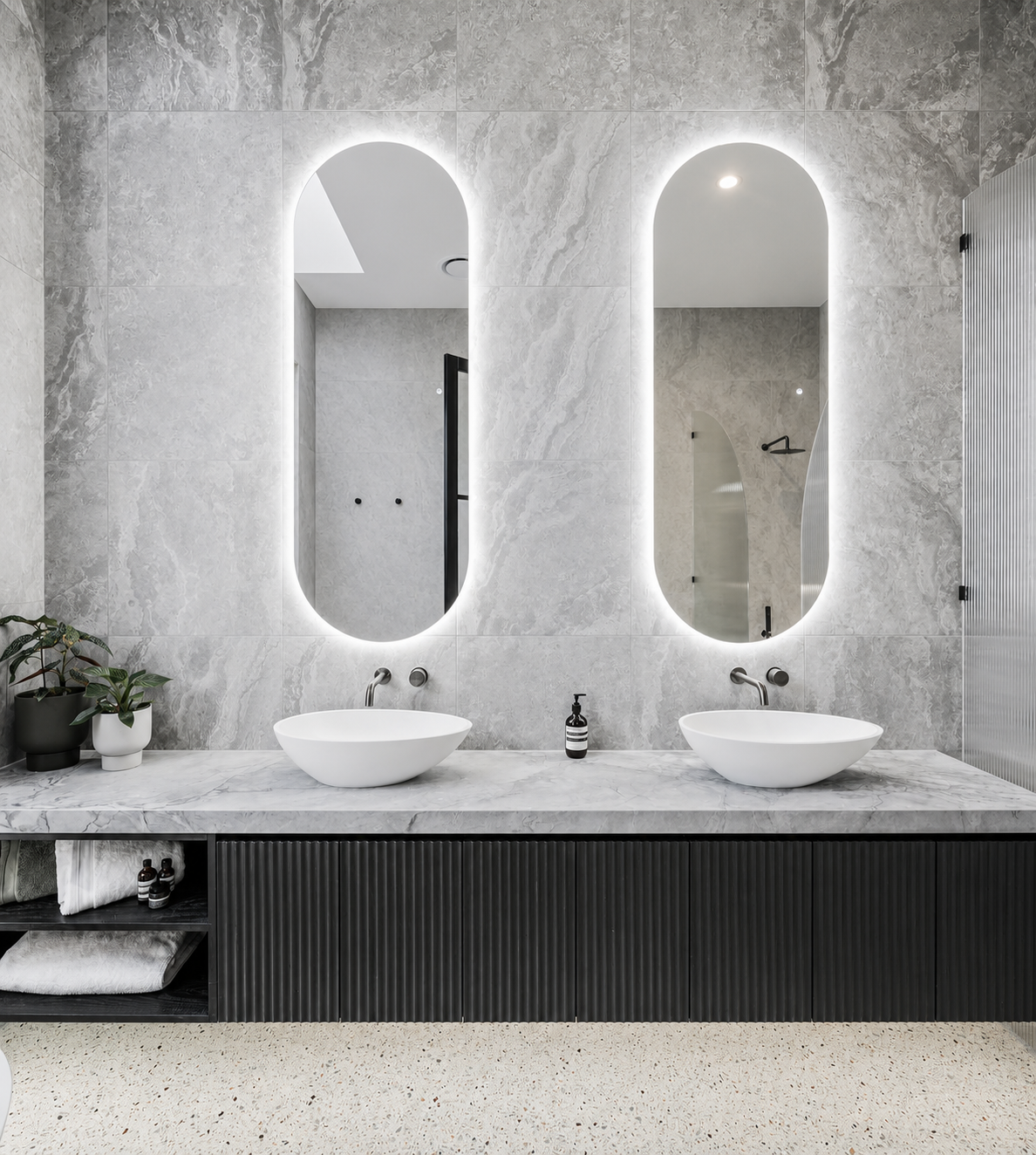
On a single vanity, shape is a free choice — pick whatever suits the style and the width. On a double vanity, shape becomes a symmetry decision first: two mirrors must be identical in shape and size, or the mismatch reads as an error rather than a design choice. Rectangle is the easiest single shape to run full-width across a double vanity, while round, arch or oval mirrors work well in pairs, one centred over each basin. For the full width and spacing breakdown, see our companion guide, How to Choose the Right Mirror Size for Your Vanity.

Expert Designer Recommendations
Designer's Rules
- Let the room's existing lines choose the shape — echo a freestanding bath's curve with round or arch, or a linear vanity with rectangle.
- Use one shape as the anchor and, if you want a second mirror elsewhere in the room, let it be a different but complementary shape rather than a competing one.
- Choose proportion over trend — a well-proportioned rectangle outlasts a fashionable shape picked for its moment.
- On a double vanity, match shape and size exactly. This is the one place where identical, not similar, is the rule.
Common Mistakes
- Wrong shape for the room: a heavily curved mirror in a hard-edged industrial bathroom, or a stark rectangle in a soft coastal one, fights the room instead of completing it.
- Ignoring ceiling height: a low, wide mirror on a high ceiling leaves the wall feeling unfinished above it.
- Ignoring vanity proportions: sizing a round mirror to the rectangle rule (or vice versa) leaves it mis-scaled for its footprint.
- Trends over timeless design: a shape picked purely because it's current can date faster than a well-proportioned classic.
- Not considering storage: falling for a shape before checking whether it's available as a cabinet, if storage is needed.
- Poor symmetry: two different mirrors, or two different sizes, on a double vanity.
- Wrong mirror scale: the right shape in the wrong size still reads as a mistake, regardless of how well it suits the style.

Shape at a Glance
A quick reference for visual effect and best room type once you've settled on style, vanity and ceiling height.
| Shape | Visual Effect | Best Room Type |
|---|---|---|
| Round | Softens hard lines, minimises visual weight | Powder rooms, ensuites, small bathrooms |
| Arch | Adds height illusion, balances soft and structured | Ensuites, premium and transitional bathrooms |
| Rectangle | Strong architectural anchor, most flexible for symmetry | Family bathrooms, double vanities, contemporary spaces |
| Organic / Irregular | Adds movement, strongest single statement piece | Guest bathrooms, statement powder rooms, eclectic interiors |
Frequently Asked Questions
What's the most popular bathroom mirror shape in New Zealand right now?
Rectangle remains the most common choice for its flexibility, but round bathroom mirrors and arch bathroom mirrors have both grown strongly as New Zealand bathrooms move toward softer, less clinical looks.
Can I mix mirror shapes in one bathroom?
Yes, as long as one shape is clearly the anchor — a rectangle over the vanity with a small round mirror near a shaving point works; two competing statement shapes in the same sightline usually doesn't.
Do round mirrors suit small bathrooms?
Very well — a round mirror can run close to full vanity width without visually overwhelming a compact room, and its soft outline reads as less bulky than a framed rectangle of the same size. For more on sizing in tight spaces, see our companion guide, Small Bathroom Mirror Guide.
Is an arch mirror a trend, or a timeless choice?
Timeless. Unlike more decorative curved shapes, the arch's straight sides keep it close enough to a rectangle's proportions that it doesn't read as a passing trend.
What mirror shape suits a bathroom with a freestanding bath?
Echo the bath's curve with a round or arch mirror rather than fighting it with a hard rectangle — the two curved forms reinforce each other across the room.
Should both mirrors on a double vanity always be the same shape?
Yes. This is the one place shape isn't a style preference — mismatched shapes or sizes on a double vanity read as an error rather than a design decision.
Designer's Cheat Sheet
Designer's Cheat Sheet
- ✔ Want timeless? → Rectangle
- ✔ Want a softer bathroom? → Round
- ✔ Want a luxury look? → Arch
- ✔ Want a statement piece? → Organic
- ✔ Need hidden storage? → Mirror Cabinet
Conclusion
Shape is the quickest way to make a bathroom mirror feel chosen rather than convenient. Round softens, arch balances curve with structure, rectangle anchors and flexes to almost any room, and organic makes a single deliberate statement. Match the shape to your room's existing lines, your ceiling height and your vanity width, and the rest of the decision — size, finish, storage — becomes far easier to make with confidence.
Whatever stage of your bathroom renovation you're at, getting the mirror shape right early makes every other decision simpler.
Still unsure which mirror shape is right for your bathroom? Explore our complete Smart Mirror and Mirror Cabinet collections to compare real examples across different sizes, styles and bathroom layouts.
Where To Next?
- By shape: Round Mirrors, Arch Mirrors, Rectangle Mirrors, Oval & Irregular Shaped Mirrors
- No storage needed: the full Smart Mirrors range
- Need storage: the full Mirror Cabinets range
- Not sure where to start: our Best Sellers
- Related guides: How to Choose the Right Mirror Size for Your Vanity and Mirror Cabinet or Bathroom Mirror?


