


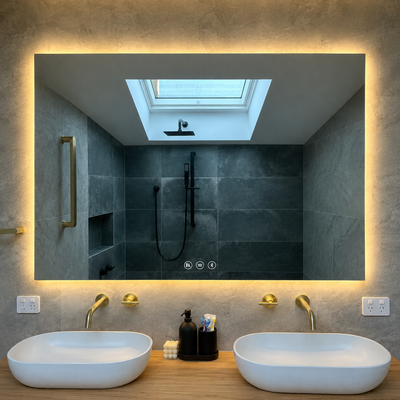
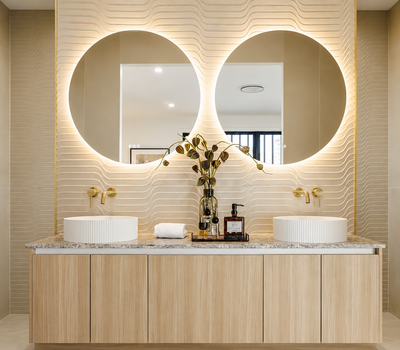
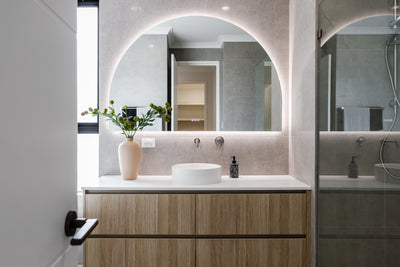
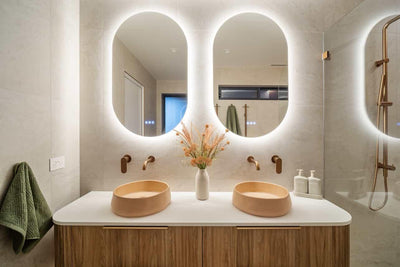



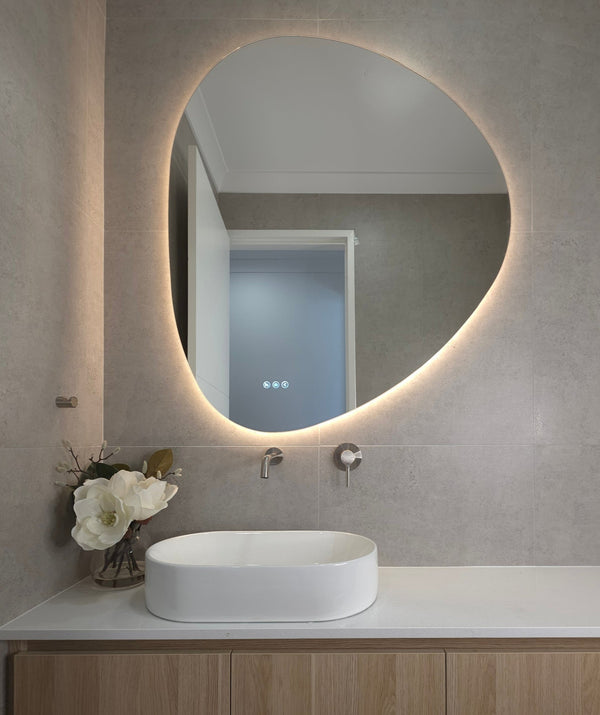
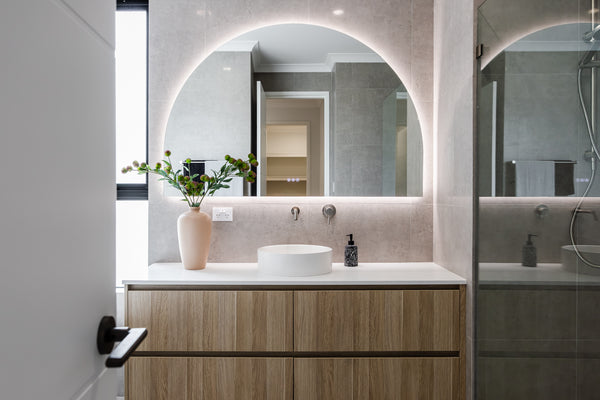
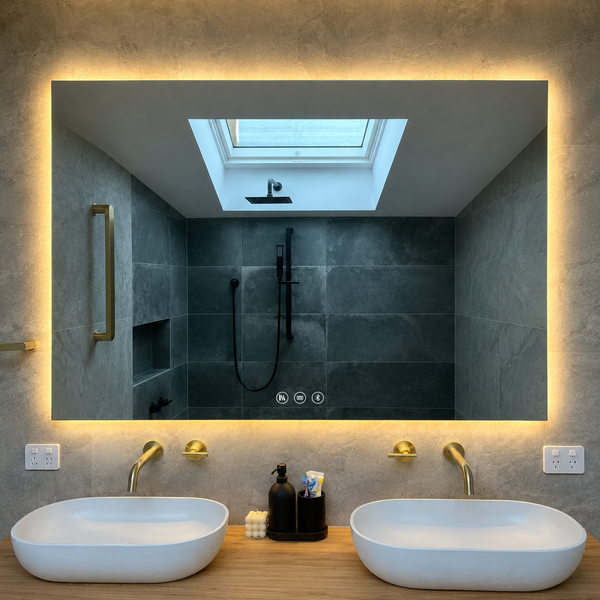
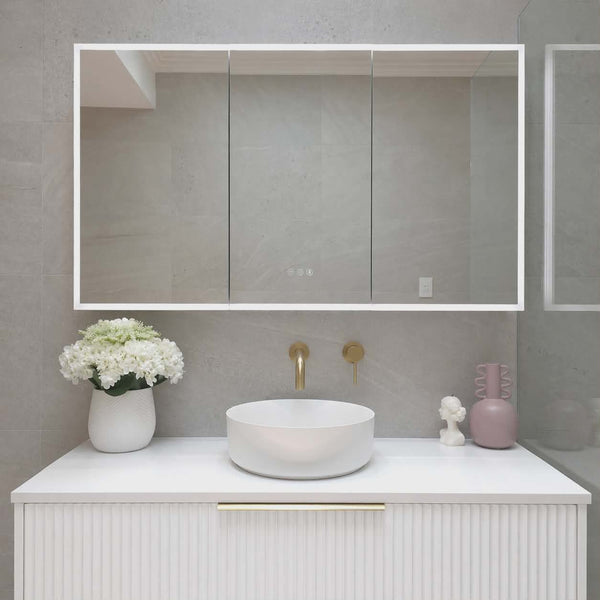

If your chrome taps work fine and you just want brushed brass, matte black or gunmetal, the job can be a short plumber visit or a tiled wall coming open. The colour you want has nothing to do with which. What decides it is where the tap's working parts live: on top of the bench, where anyone can reach them, or inside the wall behind your tiles.
This guide sorts the bathroom into what you can change without touching a tile and what you can't, explains why wall and shower mixers are the tricky ones, shows how to identify the tap you have now, and covers the question every forum thread on this topic gets to eventually: can't I just spray-paint it?
10 min read · Last reviewed 14 October 2026 · Written by Ella James
Why Trust InVogue Mirrors & Bathware? InVogue is a mirror and bathware brand trusted in over 20,000 homes, specialising in LED bathroom mirrors, mirror cabinets and tapware across every major finish. The guidance in this article reflects genuine design and maintenance considerations, not finish trends.
Quick Answer
- Basin and kitchen mixers on the bench: a straight swap. Everything that connects them is under the bench, so no tiles are touched.
- Wall and shower mixers: it depends on the valve body inside the wall. On our wall mixers, the in-wall body is the same across all six finishes of a model, so a new finish of the same model is a trim change. A different model or brand usually means a new body, and that means opening the wall.
- Towel rails, hooks and roll holders: unscrew and refit, as long as the new fixing points work with the old holes.
- Paint and wraps: decorative only. They wear on a tap that's handled wet every day, and painting ends the finish warranty.
- Who does it: changing a tap is work for an authorised plumber. Have the make and model of what you have now before you buy anything.
In this guide
What You Can Swap Without Retiling
Most of it. The only pieces that can force a wall open are the ones with a valve body buried in it: wall basin mixers, wall spouts and shower mixers. Everything on the bench, and everything that just screws to the wall, can change on its own.

Swap difficulty by fitting. "Wall opened?" assumes the tiles go back on, which is where the cost sits.
| Fitting | What changes | Wall opened? | Who | Check first |
|---|---|---|---|---|
| Basin mixer on the bench | The whole tap | No | Authorised plumber | Tap-hole size, and that the new spout reaches over the basin |
| Kitchen mixer | The whole tap | No | Authorised plumber | Clearance under the spout, and anything above the sink |
| Wall or shower mixer: same model, new finish | The visible trim (cover plate and lever) | No | Authorised plumber | That the body in the wall really is the same model. Ask us about parts first |
| Wall or shower mixer: different model or brand | In-wall body and trim | Usually | Authorised plumber, then waterproofing and a tiler | Trims aren't standard between brands, and often not between models |
| Shower head, rail or hand shower | The outlet fitting | No, if the outlet stays put | Authorised plumber | Our showers connect to a ½″ BSP outlet. A ceiling arm needs a ceiling outlet |
| Basin waste and bottle trap | Waste, plug and trap | No | Authorised plumber | Whether the basin has an overflow |
| Towel rails, hooks, roll holders | The whole piece | No | You or a handyperson | Where the new fixing points land on the tiles |
Basin and Kitchen Mixers: The Easy Swap
A basin or kitchen mixer that stands on the bench is the simplest change in the house. It's held by a fixing under the bench and fed by two flexible hoses from stop valves inside the vanity or cupboard, so an authorised plumber can take the old one off and fit the new one without going near the wall. Our tapware connects with G ½″ (½″ BSP) fittings.
The finish is the easy part. The things that catch people out are shape and size:
- The tap hole. Our Vienna Short and Vienna Tall basin mixers suit a Ø35–38 mm hole, and the Como and Porto kitchen mixers a Ø35 mm hole. Measure yours before you order.
- Height and reach. A different tap puts the water somewhere else. The Vienna Short is 175 mm tall with a 140 mm reach and 75 mm under the spout. The Vienna Tall is 305 mm tall with a 180 mm reach and 200 mm under the spout, the height a vessel basin needs. Swap one for the other without checking the basin and you can get splashing, or a spout that won't clear the rim.
- The benchtop. We don't publish a maximum benchtop thickness. If your bench is unusually thick, send us your model and a photo and we'll confirm before you buy.
If you're not sure the new shape suits your basin, our which tap fits my basin tool checks it in a minute.
 Chrome · Vienna Tall
 Antique Brass · Vienna Tall
Designer Insight: if you're swapping like for like, a short mixer for our short mixer or a tall one for our tall one, the job is usually quick. Change the height class and you're really changing the basin relationship, so check the reach and the gap under the spout first.
Wall and Shower Mixers: Why the In-Wall Body Decides Everything
Whether you can change a wall mixer without removing tiles comes down to one part you can't see. A wall mixer is two pieces: a brass valve body fixed in the wall cavity before sheeting and tiling, and the trim you see, which is the cover plate and lever (plus the spout on a wall basin set). The body is plumbed in, pressure tested and tiled over. The trim goes on at the end.
So the question is never really "can I change the colour?" It's "will the new trim fit the body that's already there?" If it will, the tiles stay. If it won't, the body has to come out, and that means opening the wall, disturbing the waterproofing behind it and retiling at least that patch.

Here's the trap. Trims aren't standard. On Bunnings Workshop, moderators point out that fittings can change between models within the same brand, so only the exact make and model is certain to fit. One homeowner there only wanted a new colour on a five-year-old wall mixer and was told the new mixer's parts wouldn't fit the body in the wall, so the wall had to come open. That's the situation to plan around.
How our wall mixers handle it
Every Invogue wall mixer uses the same in-wall body across all six finishes for a given model. A Milano Wall Mixer in Chrome and a Milano Wall Mixer in Antique Brass share the body, so changing that model's finish later is a trim change, not a wall rebuild. Before you plan it, send us your model and a photo and we'll confirm the parts you need.
Different models are different bodies, though. Our two wall mixers aren't interchangeable:
Valve depth from each product's specifications. It's measured from the finished tile face.
| Model | Valve | Valve depth in wall | What it runs |
|---|---|---|---|
| Milano Wall Mixer | 3-port valve | 45–70 mm | One outlet: a wall spout or a single shower |
| Cannes Diverter Mixer | 4-port diverter valve | 55–85 mm | Two outlets, such as an overhead shower and a hand shower |
You can't turn a Milano into a Cannes by changing the trim; that's a body change. And we don't claim our trims fit any other brand's body. If the wall mixer you have now is another brand, plan on a new body, and plan the job for when that wall is being opened anyway. Our wall-mounted vs basin mixer guide covers rough-in depth and tile thickness in detail.

Designer Insight: when you're building or renovating, buy the body and the trim from the same range at the same time. Keep the box label and the installation guide, and take a photo of the body in the wall before it's tiled over. Those three things are what make the next finish change a trim swap instead of a rebuild.
How to Identify the Tap You Have Now
Find the make and model before you buy anything. "What brand is this wall mixer?" is one of the most asked questions on renovation forums, and it's asked for a reason: it decides whether a trim swap is even possible.
Five ways to find out what's in your wall
- Look for a mark. Check the lever, the cover plate, the spout and the underside of the lever for a logo or code.
- Check the paperwork. A builder's selections schedule, a handover manual or the original invoice often names the model.
- Photograph it. Front and side of the trim, plus under the bench for a deck tap. Good photos let a supplier or plumber narrow it down.
- Ask your plumber to look behind the trim. With the lever and plate off, the body itself can carry a brand mark. If the plumber can't identify it, ask whether the body can be reached from the other side of the wall rather than through the tiles.
- If it's one of ours, send us your order number or a photo and we'll confirm the model and the parts.
Can You Paint or Wrap Tapware?
Not in a way that lasts. Paint, touch-up pens and vinyl wraps sit on top of the original finish, and a tap is handled wet, cleaned and turned many times a day. In a Bunnings Workshop thread about spray-painting chrome taps a brushed copper colour, the moderator's view was that metallic sprays are decorative and likely to rub or peel with use. Wraps have the same problem at the edges, where water gets underneath.
There's a warranty cost too. Our 3-year finish warranty covers the original surface, so a painted tap is no longer covered for its finish. If a tap works and you just want a different colour, changing the tap, or on a wall mixer of the same model the trim, is the fix that lasts. Once it's on, our tapware care guide keeps the new finish (and its warranty) intact.
Converting Two Taps to One Mixer
On the bench it depends on the holes. In the wall it means opening the wall.
- Two or three tap holes in a basin or bench. A single-hole mixer leaves the other holes open. If the holes are in the basin, the usual fix is a new basin; if they're in the benchtop, a new top, or a wall set if that wall is being opened anyway.
- Two separate wall taps to one wall mixer. That's a different body and different pipework in the wall, so the tiles in that area come off.
- Shower taps to a mixer with a diverter. Same again. A diverter mixer such as the Cannes has its own 4-port body. It's a renovation job, so time it with one.
If a conversion is part of a bigger refresh, our order of trades guide shows when each choice needs to be made, and our bathroom heights and rough-in guide gives the outlet heights your authorised plumber will ask for.
Finish the Room: Wastes, Accessories and Shower Hardware
Change the taps and the chrome waste, towel rail and shower screen hinges will suddenly stand out. Every model in our tapware and hardware range, 24 of them, comes in the same six finishes, so you can carry one finish from the basin to the door handle.
The six finishes: Antique Brass, Brushed Brass, Brushed Nickel, Brushed Gunmetal, Matte Black and Chrome.
| Room zone | Our products | Finishes |
|---|---|---|
| Basin | Vienna Short and Vienna Tall basin mixers, Milano wall spout and mixer | All six |
| Basin waste | Lisbon pop-up waste, Firenze bottle trap | All six |
| Shower | Cannes diverter mixer, Milano wall mixer, Corsica twin shower, Bordeaux wall shower, Lyon ceiling shower, Versailles hand shower | All six |
| Floor | Granada tile-insert floor waste | All six |
| Kitchen | Como kitchen mixer, Porto pull-out mixer | All six |
| Walls | Provence towel rail, Lille roll holder, Copenhagen robe hook | All six |
| Shower screen | Rennes and Geneva hinges, Rhodes clamp, Corfu door knobs | All six |
| Doors | Santorini handle, Prague lock, Venezia hinge | All six |
A few practical notes. A basin waste is plumbing, so it's part of the plumber's visit; our Lisbon pop-up suits basins without an overflow (our basin waste guide explains why that matters). A floor waste is set into the floor, so change it when the floor is being redone. Shower screen hinges and clamps are fitted to toughened glass, which is a glazier's job. Towel rails and hooks are the easy wins: new screws, and some care drilling tile.


Designer Insight: buy the pieces that sit side by side at the same time and in the same finish name. And look at them under your own bathroom light before deciding: a warm mirror light makes brass richer and gunmetal closer to charcoal. Our tapware finishes guide compares all six.
Who Does the Work, and What to Have Ready
In New Zealand, our tapware must be installed by an authorised plumber in line with the New Zealand Building Code. Some like-for-like replacement work doesn't need a building consent, but it still has to be done by an authorised person, so book the plumber for any tap, waste or shower change.
Our warranty also expects a proper install: it covers tapware installed by an authorised plumber following our installation guide. If the body in the wall is being replaced, our installation guides say to fully test it before tiling.
Have this ready for the plumber
- The new tap, still boxed, with its installation guide
- Photos of the existing tap: front, side and under the bench
- The make and model of what's in the wall, if you found it
- For a wall mixer that's changing body: your tile choice, because the valve depth is set from the finished tile face
- If the wall opens: waterproofing and then a tiler booked, after the body is tested
Common Mistakes
- Buying the new wall mixer first. Find out what body is in the wall before you choose a trim.
- Assuming any trim fits. Trims aren't standard between brands, and sometimes not between models of one brand.
- Spray-painting chrome. It looks fine for a while, then wears where hands go. It also ends the finish warranty.
- Changing a short mixer for a tall one without checking the basin. The reach and the gap under the spout change with it.
- Forgetting the waste and the towel rail. One chrome piece left behind is the first thing you notice.
- Throwing away the box and the guide. They're how you (or the next owner) identify the body later.
- Tiling over a new body before it's tested. Our guides say test first. Fixing a leak after tiling means opening the wall again.
Frequently Asked Questions
Can you replace a wall mixer without removing tiles?
Only if the new trim fits the body already in the wall. That usually means the same make and model. On our wall mixers the in-wall body is shared across all six finishes of a model, so a finish change is a trim change. A different model or brand usually needs a new body, which means opening the wall.
Can you change the colour of tapware?
Yes, by changing the tap or its trim. Benchtop basin and kitchen mixers are a straight swap with no tiles touched. Wall and shower mixers depend on the valve body in the wall: same model, new finish is a trim change; a different model usually means opening the wall. Paint and wraps don't last.
Can you spray paint chrome taps black?
You can, but it won't last. A tap is handled wet every day, and metallic or coloured sprays tend to rub through or peel. Painting also ends the finish warranty on our tapware, because the surface is no longer the original one. Changing the tap, or the trim on a wall mixer, is the lasting fix.
How do I find out what brand my wall mixer is?
Check the lever, cover plate and spout for a logo, then look for paperwork such as a builder's selections schedule or invoice. Take clear photos of the trim. A plumber can remove the lever and plate to look for marks on the body. If it's one of ours, send us a photo or your order number.
Can I change a shower mixer to one with a diverter without retiling?
Usually not. A diverter mixer runs two outlets and has a different valve body from a single-outlet mixer. Our Cannes diverter mixer uses a 4-port valve and the Milano wall mixer a 3-port valve, so moving from one to the other is a body change, and that means opening the wall.
How do I convert two taps to one mixer tap?
On a benchtop, it depends on the holes: a single-hole mixer leaves the others open, which usually means a new basin or benchtop. In a wall, two taps to one mixer is a new valve body and new pipework, so the tiles in that area come off. Either way it's work for your plumber.
Designer's Cheat Sheet
Designer's Cheat Sheet
- ✔ Bench mixers → swap at the bench, no tiles
- ✔ Wall and shower mixers → the in-wall body decides
- ✔ Our wall mixers → one body across all six finishes of a model
- ✔ Milano and Cannes → different bodies (3-port vs 4-port)
- ✔ Other brands → assume a new body unless proven otherwise
- ✔ Paint and wraps → decorative only; ends the finish warranty
- ✔ Every tap change → an authorised plumber
Conclusion
Most of a bathroom can change colour in a day. The pieces that can't are the ones with a body in the wall, and even those are a trim swap if the body and trim come from one range. Start with what you have, not with what you want: identify the model, check the body, then choose the finish.
Where To Next?
- Fixing rather than changing: Leaking Tap or Weak Flow? Cartridges, Aerators and WELS
- Wall or bench: Wall-Mounted vs Basin Mixers
- Choosing the finish: Bathroom Tapware Finishes Explained
- Looking after it: How to Clean and Care for Tapware Finishes
- Start here: the Bathroom Tapware Buying Guide
- Matching the mirror: Matching Your Mirror Frame to Your Tapware
- Shop by finish: Antique Brass, Brushed Brass, Brushed Nickel, Brushed Gunmetal, Matte Black and Chrome, or the full tapware range
Need help? Ask us with a photo. Send us a photo of your current tap through our contact page, or email info@invoguemirrors.co.nz, and we'll tell you what a finish change involves.

