

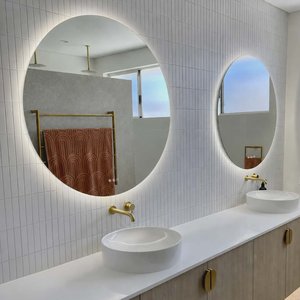
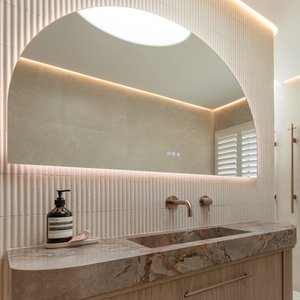
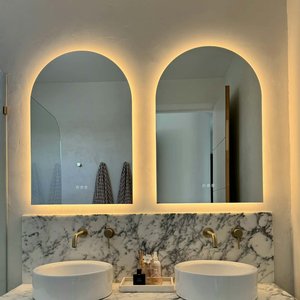
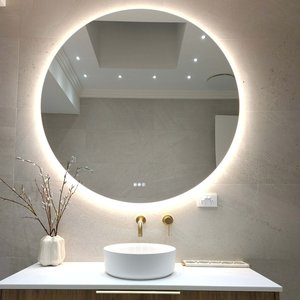
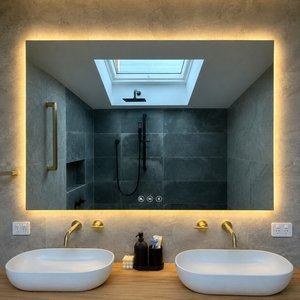
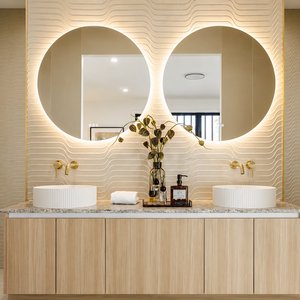

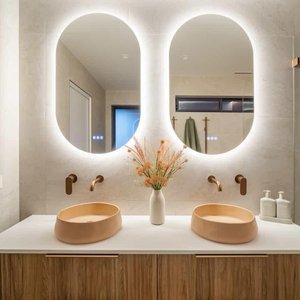
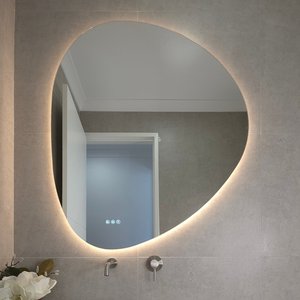
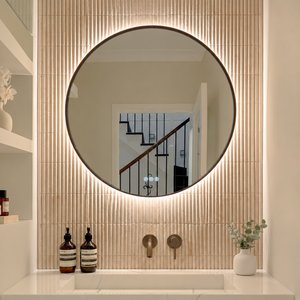
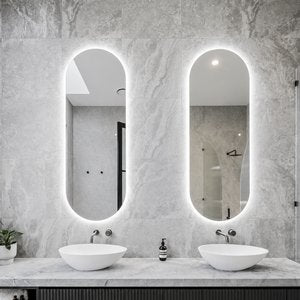


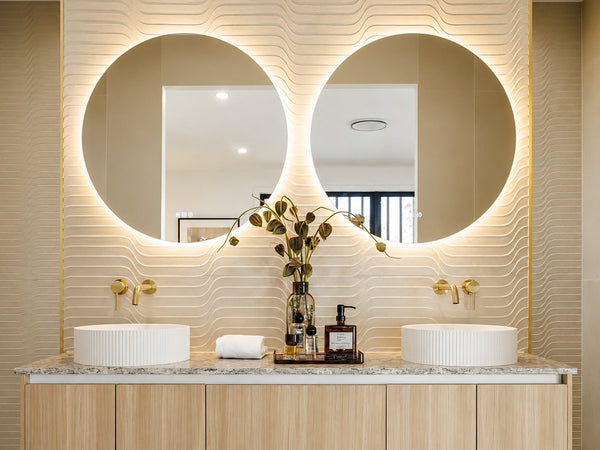
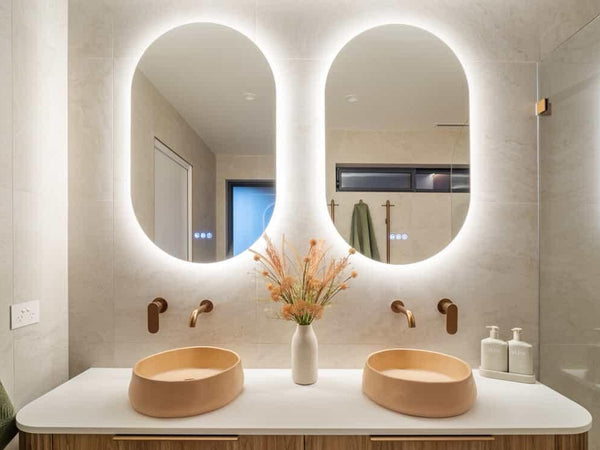
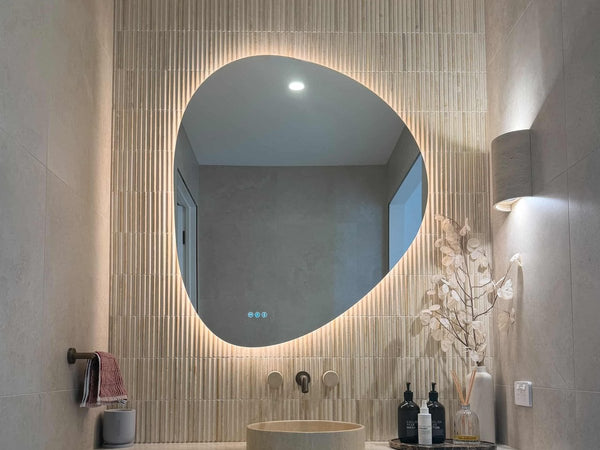
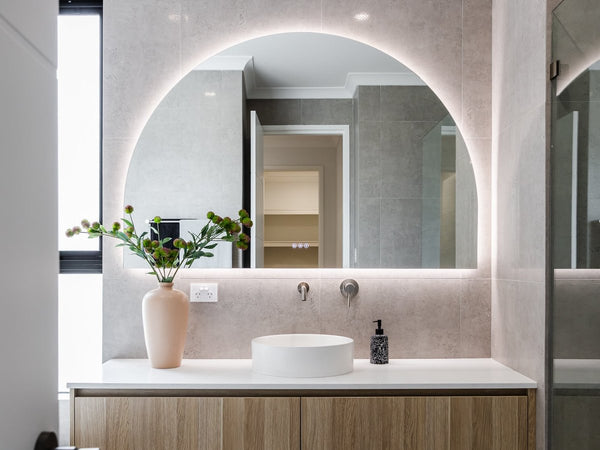
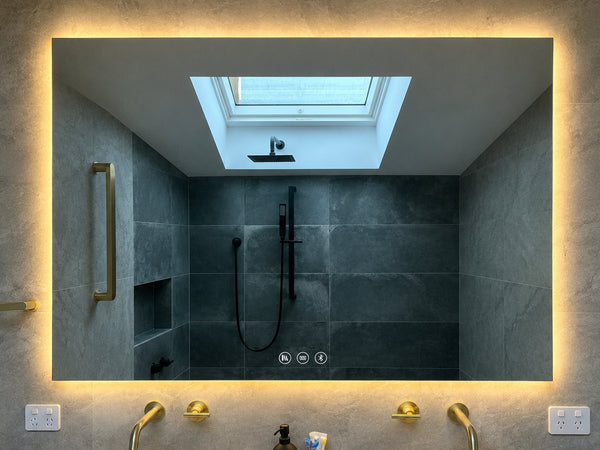
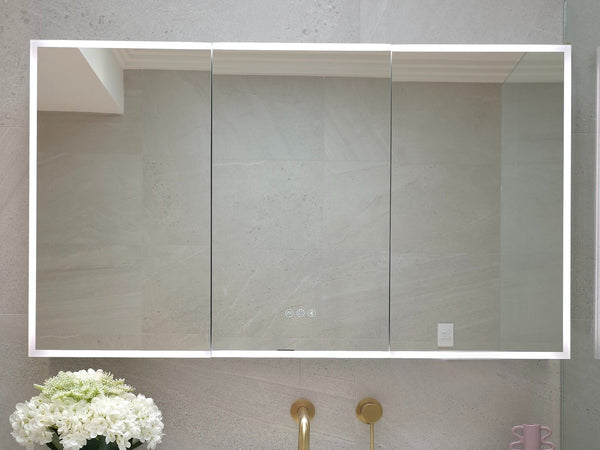
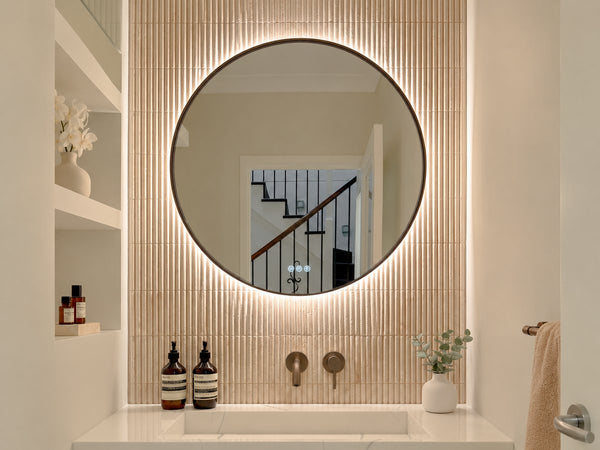
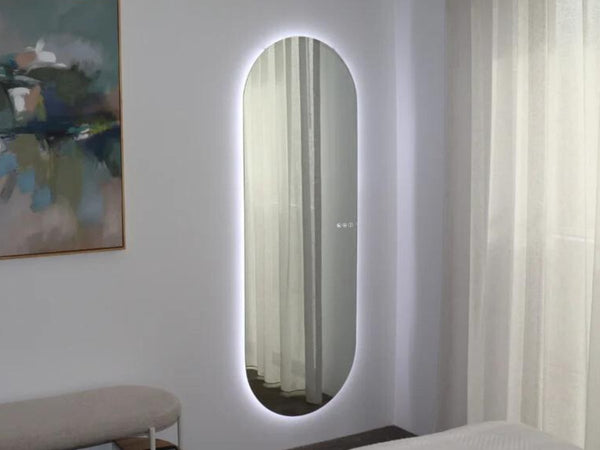

Go as wide as the vanity allows. A 600 mm vanity usually takes a 600 mm mirror, a 900 mm vanity a 900 mm mirror and a 1200 mm vanity a 1200 mm mirror. Then hang it 100–200 mm above the tap.
Most mirrors that look wrong over a vanity are the wrong width, not the wrong style. Below is a size chart for every common vanity width, from 600 to 1800 mm, filled in with the sizes we actually make, then a short answer for each width.
Updated 20 October 2026 · Written by Ella James, InVogue Mirrors & Bathware
Why Trust InVogue Mirrors & Bathware? InVogue is a mirror and bathware brand trusted in over 20,000 homes, specialising in LED bathroom mirrors and mirror cabinets. The recommendations in this guide come from bathroom design principles — proportion, balance and light — rather than passing trends.
Mirror Size Chart by Vanity Width
Find your vanity width in the first column. The two middle columns are the best fit: the largest real sizes in our range that don’t pass the vanity. The last column is one size down, for a vanity against a side wall or a tight space.
Swipe the table sideways to see every column →
| Vanity width | Best fit: mirror | Best fit: mirror cabinet | One size down |
|---|---|---|---|
| 600 mm | Amalfi or Amalfi Ambient Ø600; Positano 600 × 900; Riviera 600 × 1000; Valencia 600 × 1000 (framed) | Positano Cabinet 500 × 900 | Riviera 450 × 900; Riviera Cabinet 450 wide |
| 750 mm | Amalfi Ø700; Portofino 700 × 900 | Milan or Madrid 750 × 700 | Lune 667 × 1000; Amalfi Ø600; Positano Cabinet 500 × 900 |
| 800 mm | Amalfi or Amalfi Ambient Ø800; Capri Ø800 (framed) | Amalfi Cabinet Ø800 (surface-mount only) | Lucca 760 × 890; Lucca Cabinet 760 × 890; Milan or Madrid 750 |
| 900 mm | Florence or Venice 900 × 700 | Milan or Madrid 900 × 700 | Amalfi or Capri Ø800; Amalfi Cabinet Ø800 |
| 1000 mm | Amalfi Ø1000 | Milan or Madrid 900 × 700 | Lucca 940 × 1090; Florence or Venice 900 × 700 |
| 1200 mm | Florence, Venice or Santander 1200 × 800; Amalfi Ø1200 | Milan or Madrid 1200 × 700; Santander Cabinet 1200 × 800 | Amalfi Ø1000; Lucca 940 × 1090; a 900 mm cabinet |
| 1500 mm | Florence, Venice or Santander 1500 × 1000 | Milan or Madrid 1500 × 700 | Any 1200 mm size above |
| 1800 mm | Florence, Venice or Santander 1500 × 1000 as one mirror, or two Amalfi Ø800, one per basin | Milan or Madrid 1500 × 700 | Florence, Venice or Santander 1200 × 800 |
Between two rows? Work it out the same way: take the largest size that doesn’t pass your vanity. A 1050 mm vanity takes the 1000 mm Amalfi round, with the 940 mm Lucca one size down.
Type your vanity width on any mirror or cabinet page
The Check it fits your vanity panel labels every size for your vanity and draws the best fit to scale over your benchtop.
Check a mirrorCheck a cabinetWhat Size Mirror for a 600 mm Vanity?
A 600 mm mirror. The Amalfi Ø600 round, the Positano 600 × 900 arch, the Riviera 600 × 1000 pill and the framed Valencia 600 × 1000 all fill a 600 mm vanity without passing it. For storage, the Positano Cabinet at 500 × 900 mm is the largest cabinet that fits, and the Riviera Cabinet at 450 mm wide is one size down.
On a narrow powder-room wall, a tall shape earns its place: you get a full-height reflection without any extra width. We don’t usually recommend the jump to 700 mm: a 700 mm round on a 600 mm vanity hangs past the benchtop at both ends.
What Size Mirror for a 750 mm Vanity?
A 700 mm mirror, or a 750 mm cabinet. We don’t make a 750 mm mirror, so the best fit is the Amalfi Ø700 or the Portofino 700 × 900. Cabinets do come in 750: the Milan and Madrid at 750 × 700 mm fill the vanity exactly.
One thing to check with that cabinet: its two doors hinge on the outer edges and open to 110°, so they swing out past the sides. If the vanity sits between walls, the Positano Cabinet (500 mm, one door) is the easier fit. The 760 mm Lucca is wider than a 750 mm vanity, so we don’t usually recommend it here.
What Size Mirror for an 800 mm Vanity?
An 800 mm round. The Amalfi, Amalfi Ambient and framed Capri all come at Ø800, and the Amalfi Cabinet is Ø800 too. The Amalfi Cabinet is surface-mount only, so it can’t be set into the wall. One size down is the Lucca at 760 × 890 mm, as a mirror or a cabinet, or a 750 mm Milan or Madrid cabinet.
What Size Mirror for a 900 mm Vanity?
A 900 mm mirror. The Florence and Venice at 900 × 700 mm are as wide as the vanity, and for storage the Milan or Madrid cabinet at 900 × 700 mm does the same. If the vanity sits against a side wall, or a window frame, switches, towel rails or a door swing make it tight, choose one size down: the 800 mm rounds and the 800 mm Amalfi Cabinet leave about 50 mm of wall each side.
We don’t usually recommend the 940 mm Lucca, the Amalfi Ø1000 or any 1200 mm size here: each is wider than the vanity.

What Size Mirror for a 1000 mm Vanity?
The Amalfi Ø1000 round, our only 1000 mm size. Rectangles step from 900 to 1200 mm, so the rectangular choice is the Florence or Venice at 900 × 700 mm, and the organic Lucca at 940 × 1090 mm sits in between. For a cabinet, the Milan or Madrid at 900 mm is the largest that fits.
What Size Mirror for a 1200 mm Vanity?
A 1200 mm mirror. The Florence, Venice and Santander come at 1200 × 800 mm, and the Amalfi at Ø1200. For storage: the Milan or Madrid at 1200 × 700 mm (three doors), or the Santander Cabinet at 1200 × 800 mm, an arch whose doors open from the middle.
One size down is the Amalfi Ø1000, the Lucca 940 × 1090 or a 900 mm rectangle or cabinet.
What Size Mirror for a 1500 mm Vanity?
A 1500 mm mirror. The Florence, Venice and Santander all come at 1500 × 1000 mm. The widest cabinets are the Milan and Madrid at 1500 × 700 mm, with three doors. If 1500 won’t fit the wall, every 1200 mm size is one size down.
What Size Mirror for an 1800 mm or Double Vanity?
One wide mirror, or one mirror per basin. Our widest single mirrors are the Florence, Venice and Santander at 1500 × 1000 mm, with the 1200 × 800 mm sizes one size down.
For two basins, two Amalfi rounds at 800 mm are the easy pairing. When each basin sits in the middle of its half of the vanity, the fit check shows them about 100 mm apart. If your basins are off-centre, centre each mirror on its own tap, not on half the benchtop, and hang both at the same height. The widest single cabinet is the Milan or Madrid at 1500 × 700 mm. Our double vanity mirror guide covers spacing in more depth.

Can a Mirror Be the Same Width as the Vanity, or Bigger?
The same width, yes. Wider, we don’t usually recommend. A mirror as wide as the vanity lines up with the edge of the benchtop, so the two read as one piece, and you get the most glass and light for the wall you have. That’s why our fit check labels the largest size up to your vanity width as the Best fit.
We don’t usually recommend going wider than the vanity. A mirror that overhangs the benchtop can look like it came from a bigger bathroom, and in a tight room the extra width is what runs into a side wall, a shower screen or a towel rail. For a round mirror, the width is its diameter, and round or shaped mirrors often look right a little narrower.
How Wide Should Your Mirror Be? It’s Your Call
There’s no single right size. It depends on your bathroom and the look you want. We generally recommend the largest size that’s no wider than your vanity. When in doubt, size up, if the space allows it; if a side wall, tiles or the door make it tight, go one size down. Some guides suggest a mirror around 70–80% of the vanity width. Many of our customers prefer to go as wide as the vanity, which looks balanced and makes the most of the space, especially when the vanity sits in an open spot with room either side.
Then check your space:
- Vanity against a side wall? Leave room for tiles, light switches, towel rails and, for cabinets, the door swing. If it’s tight, choose one size down.
- Round or shaped mirror? These often look right a little narrower than the vanity.
- Double basins? One wide mirror or two smaller ones both work. It’s a matter of taste.
- Tap position: leave 100–200 mm between the top of the tap or splashback and the bottom of the mirror.
Not sure? Send us a photo and your vanity width, and we’ll suggest the sizes that fit.
How High to Hang It, and Should It Touch the Splashback?
Leave 100–200 mm between the top of the tap or splashback and the bottom of the mirror, never less than 100 mm. Measure from whichever is higher, the tap or the splashback, not from the benchtop. The mirror shouldn’t touch the splashback.
- As a guide, the centre of the mirror sits about 1500–1650 mm above the finished floor.
- Keep the top edge about 100–150 mm below the ceiling or cornice.
- Over a double vanity, hang both mirrors at the same height.
With a tall basin mixer, keep the gap at the lower end of that range and choose a taller mirror, rather than lifting a short one up the wall. Our mirror height guide has the full chart, and bathroom heights and rough-in measurements puts every fixture on one drawing.

How to Measure Your Vanity for a Mirror
- Measure the top. Run the tape across the benchtop, edge to edge, in millimetres. Not the cabinet underneath: a stone top often overhangs it at each end.
- Count the basins. With two, also measure between the centres of the two taps.
- Check what’s beside it. A side wall, shower screen, towel rail or window frame can rule out the full width, and cabinet doors need room to swing.
- Find the highest point. Measure to the top of the tallest tap, spout or splashback. The mirror starts 100–200 mm above it.
- Check it on the product page. Type the width into Check it fits your vanity.

Check It Fits Your Vanity Before You Order
Every LED mirror and mirror cabinet page has a Check it fits your vanity panel under the size options. Type the width of the top of your vanity, press Check, and each size is labelled for your vanity. The best fit is drawn to scale over your benchtop, and on cabinet pages you can open the doors in the drawing to see whether they reach a wall or screen.

Frequently Asked Questions
What size mirror for a 900mm vanity?
Up to 900 mm wide: the Florence or Venice at 900 × 700 mm fills the vanity without passing it, and for storage a Milan or Madrid cabinet at 900 mm does the same. If the vanity sits against a side wall or space is tight, choose one size down: an 800 mm round such as the Amalfi or Capri, or the 800 mm Amalfi Cabinet.
What size mirror for a 1200mm vanity?
Up to 1200 mm wide: the Florence, Venice or Santander at 1200 × 800 mm, or the Amalfi round at 1200 mm. For storage, a Milan or Madrid at 1200 × 700 mm or the Santander Cabinet at 1200 × 800 mm. One size down is the Amalfi at 1000 mm, the Lucca at 940 mm or a 900 mm rectangle.
Should a bathroom mirror be the same size as the vanity?
It can be. Going as wide as the vanity is usually the best fit, if the space allows. A mirror as wide as the benchtop lines up with it and gives you the most glass for the wall.
Should a bathroom mirror be bigger or smaller than the vanity?
We don’t usually recommend bigger. A mirror that passes the edge of the benchtop can look out of proportion and can run into a side wall, screen or towel rail. We generally recommend the largest size that’s no wider than your vanity. When in doubt, size up, if the space allows it; if a side wall, tiles or the door make it tight, go one size down. Some guides suggest around 70–80% of the vanity width; many of our customers prefer to go as wide as the vanity, and round or shaped mirrors often look right a little narrower.
Should a bathroom mirror touch the backsplash?
No. Leave 100–200 mm between the top of the splashback or tap, whichever is higher, and the bottom of the mirror, and never less than 100 mm. Our installation guides say the mirror should not touch the splashback.
What size mirror for a double vanity?
Either one wide mirror, such as the Florence, Venice or Santander at 1500 × 1000 mm, or one mirror per basin. Two Amalfi rounds at 800 mm suit an 1800 mm vanity, each centred on its own tap and hung at the same height.
How do you measure for a vanity mirror?
Measure across the top of the benchtop, edge to edge, in millimetres, not the cabinet below. Note how many basins you have, check what sits beside the vanity, and measure to the top of the tallest tap or splashback. Then type the width into Check it fits your vanity on any of our mirror or cabinet pages.
Designer's Cheat Sheet
Designer's Cheat Sheet
- ✔ Width → match the vanity width
- ✔ Side wall or tight space? → one size down
- ✔ 600 → 600 mm round, arch or pill · 900 → 900 × 700 · 1200 → 1200 × 800 or Ø1200
- ✔ Gap above the tap or splashback → 100–200 mm, never under 100 mm
- ✔ Cabinet → check the doors clear walls and screens
- ✔ Not sure → Check it fits your vanity on any product page
Where To Next?
- Hanging it: How High Should You Hang a Bathroom Mirror?
- Choosing a shape: Round vs Arch vs Rectangle Bathroom Mirrors
- Small rooms: Best Bathroom Mirrors for Small Bathrooms
- Storage: The Ultimate Mirror Cabinet Buying Guide (every cabinet size, depth and recess cut-out), or Mirror Cabinet or Bathroom Mirror?
- Shop by shape: Round, Arch and Rectangle mirrors, or the full Mirror Cabinets range
Need help? Ask us with a photo.
Send us a photo of your vanity and wall, or your plans, and we’ll tell you which sizes fit. Email info@invoguemirrors.co.nz.

